Web UI renders javascript code in ML Engine name leading to XSS
September 12, 2024

Products Impacted
The vulnerability is present in all versions of the MindsDB project.
CVSS Score: 9.0
AV:N/AC:L/PR:L/UI:R/S:C/C:H/I:H/A:H
CWE Categorization
CWE-79: Improper Neutralization of Input During Web Page Generation (‘Cross-site Scripting’)
Details
To exploit this vulnerability, an attacker authenticated to a MindsDB instance could craft a dataset as shown below:
feature1,quality
<img src='#' onerror=alert("sample1") />, 5
Once this has been created, the attacker can upload the file, and the javascript code will be run in the victim’s browser when they attempt to view the contents of the dataset within the UI, as shown below:
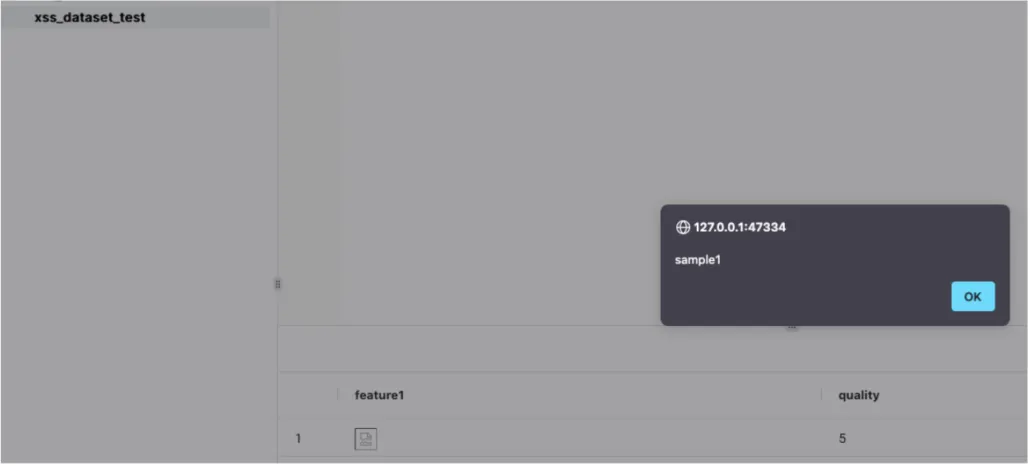
As can be seen in the above screenshot, the rendering occurs within the table.
Timeline
July, 12 2024 — Vendor disclosure via process outlined in SECURITY.md
July, 23 2024 — Update made to project Github repository in version v24.7.4.1 replacing use of ‘eval’ with ‘ast.literal_eval’. This affects some of our submitted CVEs and can be seen here
July, 29 2024 — Follow up email sent to vendor
September, 6 2024 — Final attempt to reach out to vendor prior to public disclosure date
September, 10 2024 — Received response from vendor saying they had put a number of changes in place to “mitigate some or all of the reported issues”
September, 12 2024 — Public disclosure
Project URL
https://github.com/mindsdb/mindsdb
Researcher: Kieran Evans, Principal Security Researcher, HiddenLayer
Researcher: Leo Ring, Security Research Intern, HiddenLayer
Researcher: Kasimir Schulz, Principal Security Researcher, HiddenLayer
Related SAI Security Advisory
September 11, 2026
_READ_ONLY_COMMANDS_POSIX expansion adds 31 commands with no path checking, granting unconditional access to the full host filesystem
Mistral Vibe automatically approves a large set of commands that are not subject to the expected workspace path restrictions, allowing files anywhere on the host to be accessed without user approval.
September 11, 2026
Environment variable prefixes stripped from permission check enable RCE via env injection
Mistral Vibe does not consider environment variable assignments when checking whether a command can run without approval, allowing environment controlled behavior in allowlisted programs such as Git to be abused for arbitrary code execution.