For the best experience, this project uses the Webflow Input Enhancer extension. We highly recommend installing it. Click here to download (use preview mode to access link)
2026 AI Threat Landscape Report
Gain/Get Control of Enterprise AI Risk
See every AI asset, validate every model, test for real attacks, and stop threats in real time.
Trusted by Industry Leaders
CISO Challenges With Securing AI
AI risk is increasing fast and traditional security can’t adapt
CISOs face four core AI security gaps that legacy tools cannot solve.
No enterprise visibility into AI usage
Security teams do not know where models, agents, and AI workflows exist across the business.
One platform that solves the four core AI security gaps
Each HiddenLayer module directly maps to a real CISO level risk.
01
AI Discovery
Where is my AI?
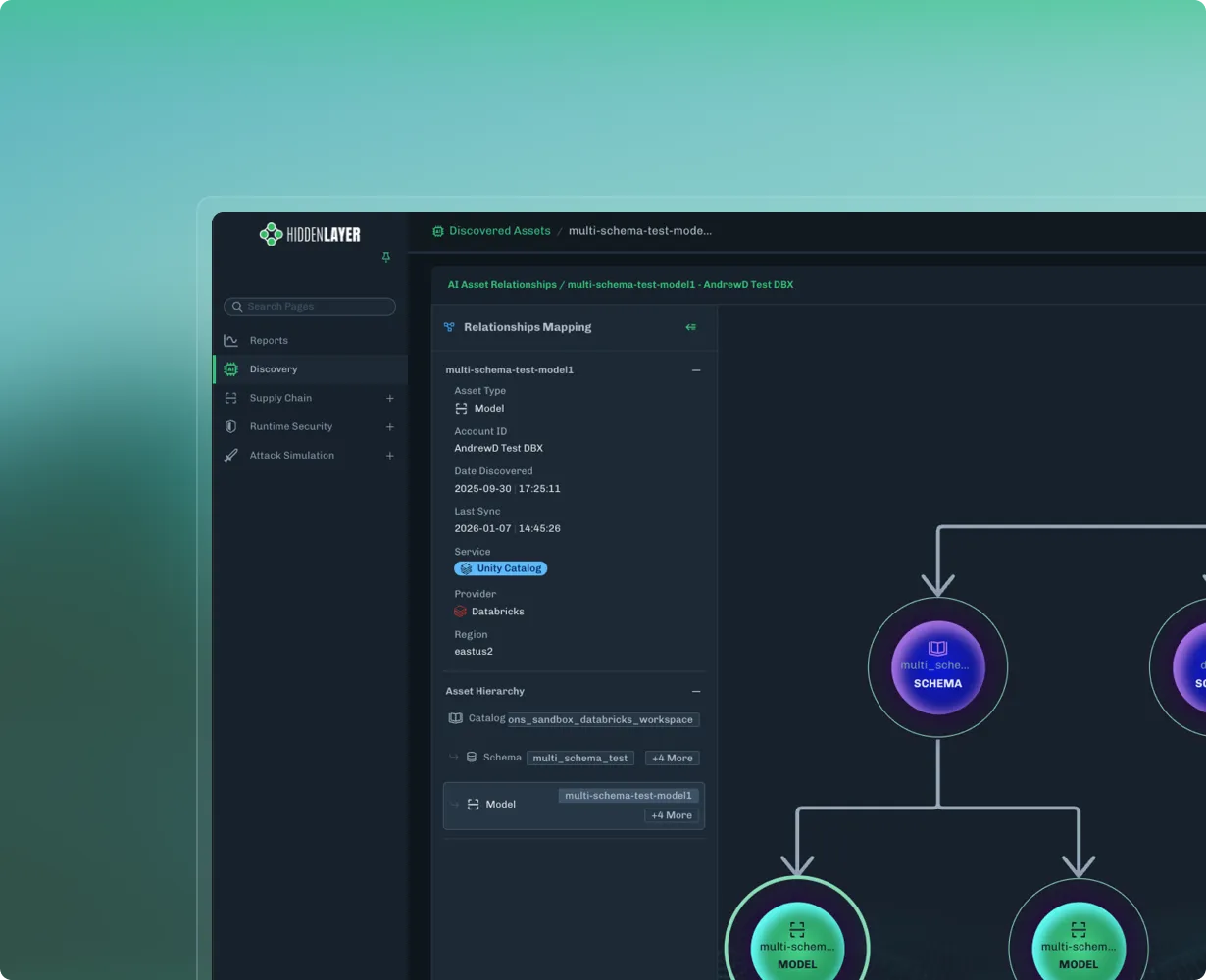
Automatically discover every model, dataset, agent, and AI workflow across cloud, repos, and applications so security knows exactly what exists and who owns it.
02
ai supply chain security
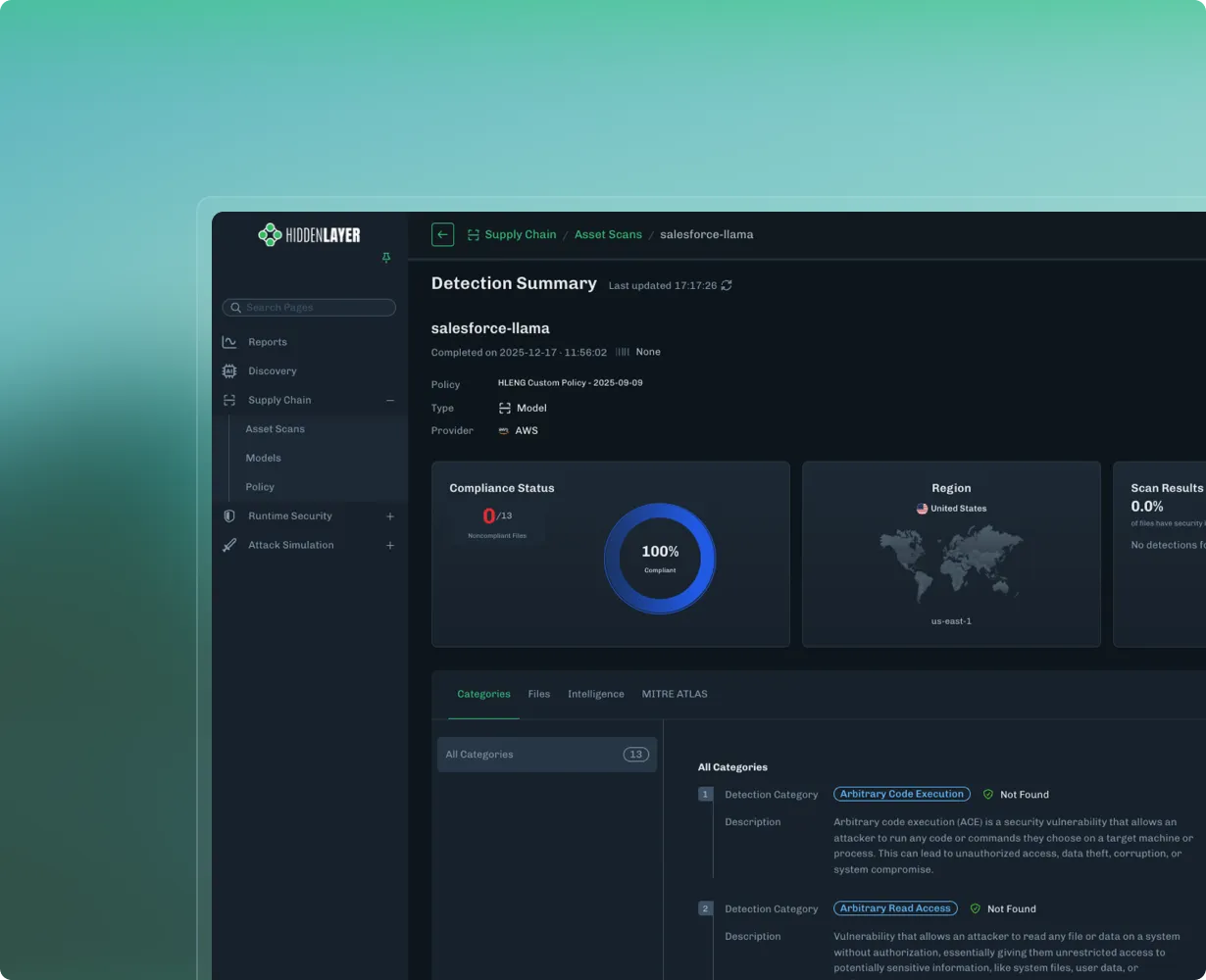
Is my AI safe to use?
Scan proprietary, vendor, and open source models for malware, backdoors, CVEs, integrity issues, and inherited risk before models reach production.
03
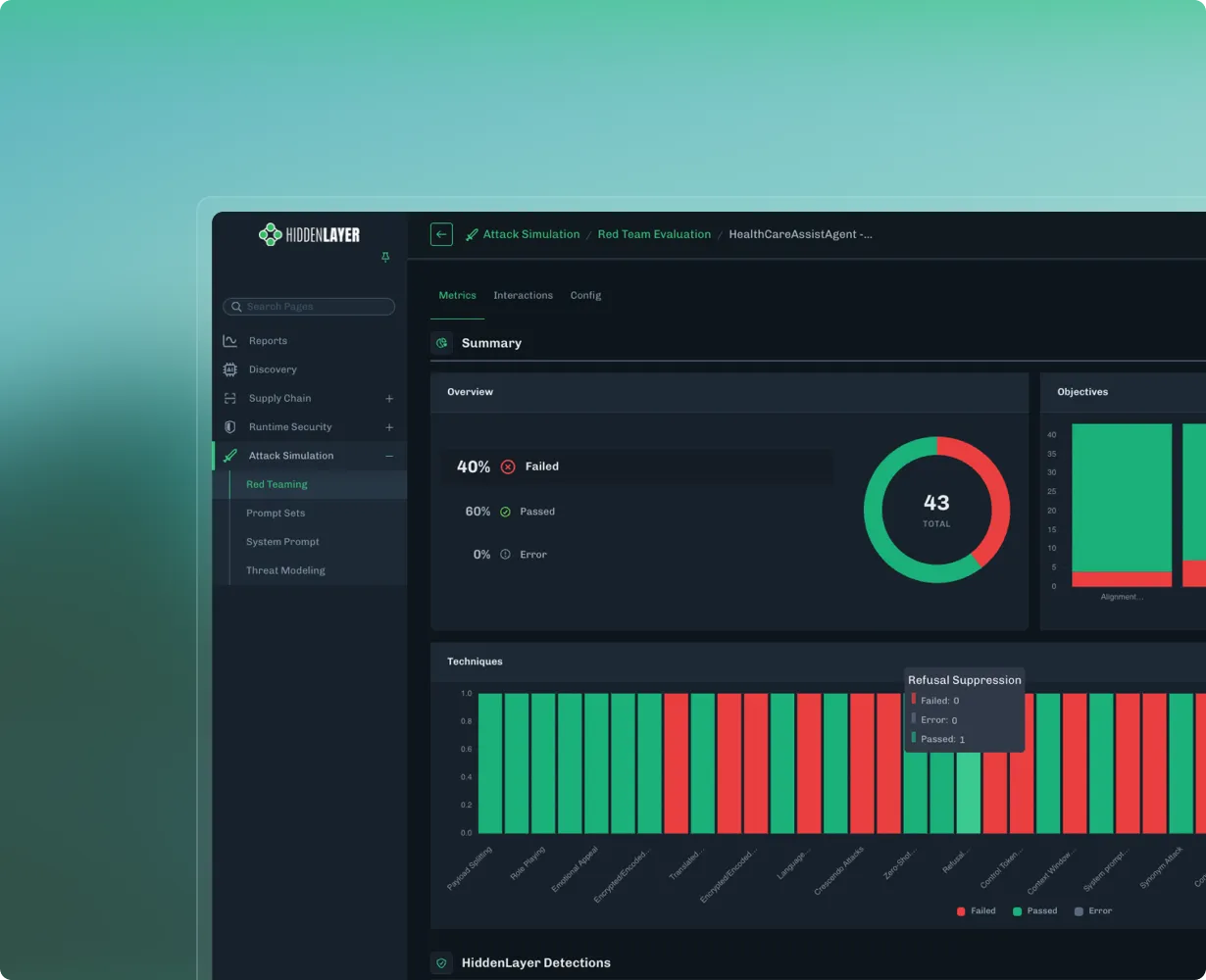
ai attack simulation
How will my AI behave under attack?
Continuously red team AI systems to simulate prompt injection, jailbreaks, data extraction, and adversarial abuse before attackers exploit gaps.
04
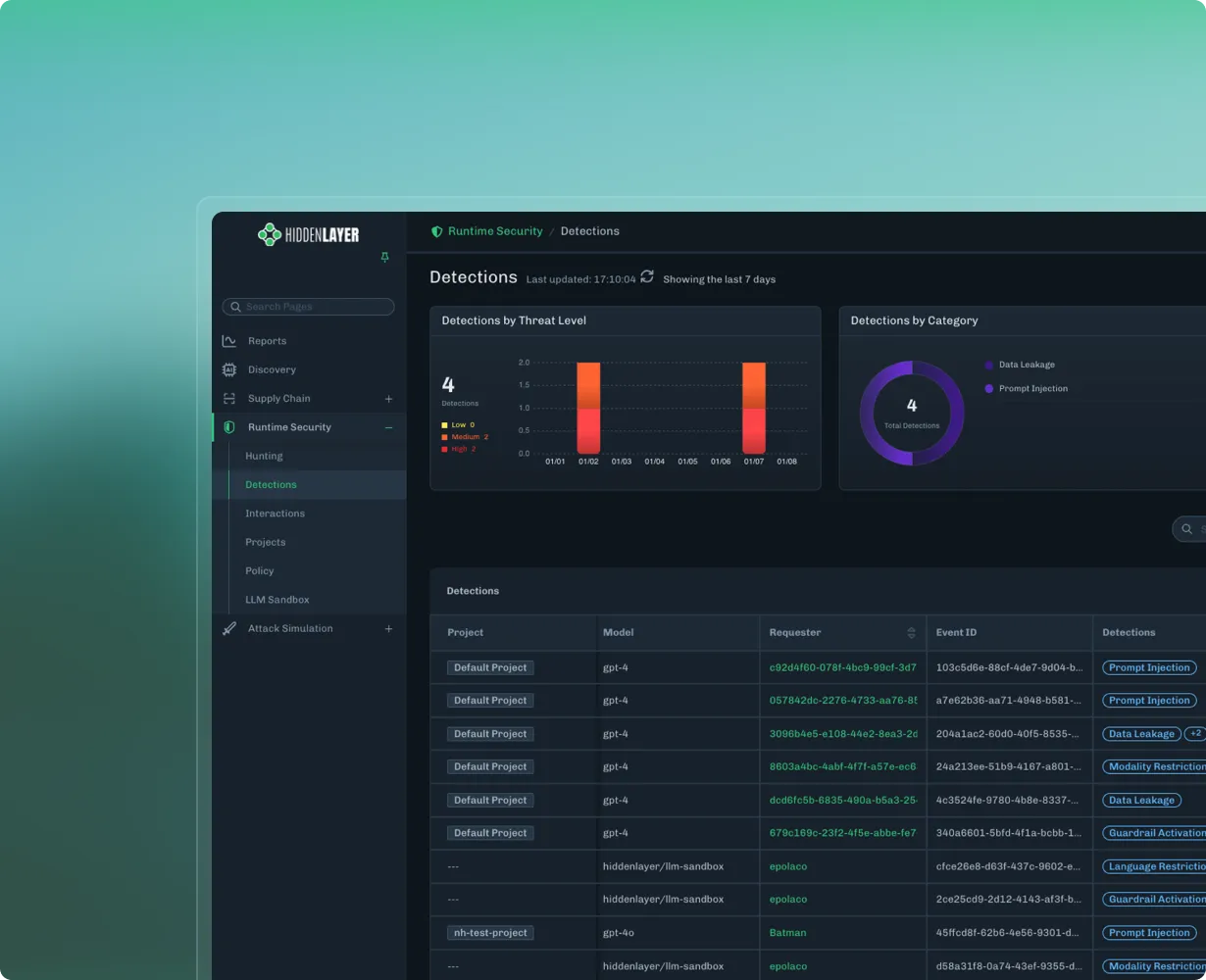
ai runtime security
How can I protect my AI?
Monitor prompts, outputs, memory, and agent actions in real time to detect and block prompt injection, data leakage, model theft, and unsafe tool use.
What CISOs gain with HiddenLayer
Full enterprise AI visibility
Know where AI exists and how it is used.
Reduced third party and open source risk
Block unsafe models before deployment.
Continuous AI threat validation
Test defenses before attackers do.
Real time AI incident response
Detect and block live AI attacks.
"As enterprises embrace AI, security can’t be an afterthought. HiddenLayer makes it possible for CISOs to lead with confidence and keep innovation secure."
Tomas Maldonado
CISO, NFL
"Securing AI requires protection across the entire lifecycle. HiddenLayer delivers end-to-end visibility and defense so CISOs can safeguard AI at every stage."
Jerry Davis
Founder, Gryphon X
"Strong governance is critical as AI becomes embedded across enterprises. HiddenLayer provides the comprehensive framework needed to manage risk and align AI adoption with visibility, compliance, and accountability."
Gary McAlum
Prior CISO, AIG
"The integrity of AI systems is as critical as the integrity of our software supply chains. If we can't secure the building blocks of AI, we risk exposing enterprises to new classes of attack. HiddenLayer is tackling this problem at its root, delivering the protections the world needs most."
Thomas Pace
Co-Founder & CEO, NetRise
"AI introduces risks that traditional cybersecurity tools weren't built to handle. HiddenLayer's comprehensive platform consolidates what CISOs need to manage and defend the critical AI tools that enable the business."
Timothy Youngblood
CISO in Residence, Astrix Security
"AI security demands purpose-built technology and trusted partners to counter AI attack vectors. HiddenLayer arms CISOs with a comprehensive platform to identify and manage AI-specific risks, enabling organizations to innovate with confidence and at the speed of modern business."
Josh Lemos
CISO, GitLab
"One of the elements that impresses me about HiddenLayer is the elegance of their technology. Their non-invasive AIDR solution provides robust, real-time protection against adversarial attacks without ever needing to access a customer's sensitive data or proprietary models. This is a game-changer for enterprises in regulated industries like finance and healthcare, as well as federal agencies, where data privacy is paramount."
Doug Merritt Chairman
CEO & President at Aviatrix and prior CEO at Splunk
Resources
Learn from the Industry’s AI Security Experts
Research, guidance, and frameworks from the team shaping AI security standards.

insights
XX
min read
NSPM-11 Elevates AI Security from Best Practice to National Security Requirement
NSPM-11 elevates AI security to a national security requirement. Learn how AI assurance, model security, and threat detection support trusted AI adoption
On June 5, 2026, the White House released National Security Presidential Memorandum-11 (NSPM-11), establishing a framework for accelerating AI adoption across the national security enterprise. One detail stands out from a security perspective: Section 4(c) explicitly directs leaders to secure advanced AI systems, including protection against malicious distillation attacks.
Presidential directives rarely reference specific attack techniques. By naming model distillation directly, NSPM-11 acknowledges a reality security teams have been confronting for years: AI systems are now strategic assets and attack targets. Protecting those systems from theft, manipulation, and misuse is a national security requirement.
The memorandum organizes the national security enterprise around four pillars: Adoption, Adaptation, Assurance, and Accountability. While much of the discussion around NSPM-11 has focused on accelerating AI deployment, the Assurance pillar deserves equal attention. It is the foundation that enables organizations to adopt AI confidently and securely.
Understanding the Three AI Challenges
Discussions about AI security often blur together three distinct disciplines:
AI for Cybersecurity: Using AI to improve security operations, threat detection, vulnerability management, and defensive capabilities.
Responsible AI: Ensuring AI systems operate safely, ethically, and in compliance with applicable laws, policies, and governance requirements.
AI Security: Protecting AI systems themselves from theft, manipulation, compromise, and adversarial attacks.
While these disciplines are complementary, they address different risks and require different controls.
Responsible AI programs help organizations manage governance and compliance risks, but they are not designed to identify model backdoors or model theft. AI-powered cybersecurity tools may improve detection and response capabilities, but they do not inherently protect the models themselves from attack.
AI security focuses on a different question entirely: Can an adversary manipulate, steal, poison, or otherwise compromise the model?
That distinction is central to NSPM-11's Assurance pillar and highlights why AI security has emerged as its own cybersecurity discipline.
The Significance of NSPM-11's Definitions
One of the most important aspects of NSPM-11 is how it defines AI security. The memorandum defines AI security as applying protection mechanisms across the AI technology stack to ensure the confidentiality, integrity, and availability of AI systems from design through deployment.
This aligns AI security with established cybersecurity principles while recognizing that AI introduces unique attack surfaces. The policy also broadens the concept of AI incident response to include adversarial attacks against AI systems themselves, reinforcing the need to monitor, defend, and validate AI models like any other critical technology asset.
This shift is significant because it formally recognizes AI systems as operational assets that require dedicated security controls. Threats such as prompt injection, model extraction, training data poisoning, and model backdoors are no longer theoretical concerns. They are security risks that organizations must be prepared to detect, investigate, and respond to.
Assurance Requires Independent Verification
The Assurance pillar emphasizes maintaining visibility and control over mission-critical AI systems.
NSPM-11 requires mechanisms that prevent AI systems from being materially modified without government knowledge and approval. This reflects two realities facing organizations adopting AI at scale.
First, AI systems can be intentionally manipulated. Adversaries may attempt to alter a model's behavior through tampering, poisoning, or the introduction of hidden functionality.
Second, organizations must maintain independent visibility into the AI systems they rely on. As agencies deploy models from commercial providers, open-source communities, and internal development teams, they need the ability to verify model integrity regardless of where the model originated.
This requirement naturally favors security capabilities that operate independently of any single model vendor. As the AI ecosystem becomes increasingly diverse, organizations need assurance mechanisms that can evaluate and secure AI systems consistently across different model architectures, deployment environments, and suppliers.
Equally important, those assurance mechanisms should align with established frameworks such as MITRE ATLAS, the NIST AI Risk Management Framework (AI RMF), and emerging federal AI security guidance. Aligning AI security programs with recognized frameworks enables organizations to consistently evaluate risk, validate security controls, and demonstrate assurance through transparent, repeatable methodologies.
What AI Security Looks Like in Practice
The threats addressed by NSPM-11 are not hypothetical.
HiddenLayer researchers demonstrated this challenge through ShadowLogic, a technique that embeds malicious behavior directly within a model's computational graph rather than in traditional software components.
Because these manipulations exist within the model itself, they can evade conventional malware detection approaches and persist through common model transformations. Research has demonstrated that these types of backdoors can remain dormant until triggered by specific conditions, highlighting a key challenge for AI security: many AI threats lie beyond the visibility of traditional security controls, making specialized model analysis and validation essential before deployment.
However, securing AI systems extends beyond model artifacts alone.
At deployment and runtime, organizations must contend with attacks such as prompt injection, jailbreaks, sensitive data extraction, and other adversarial techniques that target model behavior through inference interactions. Many of these risks are now well documented within industry frameworks, including the OWASP Top 10 for LLM Applications and MITRE ATLAS. These resources provide a common language for understanding AI attack techniques and reinforce the need for security controls that continuously monitor model interactions and behavior in production environments.
At the strategic level, NSPM-11 specifically calls out model distillation attacks, in which an adversary repeatedly queries a deployed model to replicate its capabilities in another system. In these cases, the attacker may never gain direct access to model weights or infrastructure. Instead, they extract value through interaction.
These threats occur at different stages of the AI lifecycle, which is why effective AI security requires a layered approach. Model integrity validation, runtime monitoring, adversarial testing, and continuous assessment each address different aspects of the attack surface.
The principle is familiar to every security practitioner: defense in depth applies to AI just as it does to traditional systems.
Why AI Security Is a Distinct Discipline
NSPM-11 reinforces why AI security has emerged as a dedicated cybersecurity discipline.
Traditional security controls remain essential, but they were not designed to identify model backdoors, detect attempts to extract models, or analyze machine learning artifacts for signs of tampering.
Addressing these risks requires capabilities focused specifically on AI systems, including:
Model scanning and artifact analysis
Runtime monitoring for AI-specific attacks
Adversarial testing and AI red teaming
Continuous validation of model integrity
AI-focused incident response and investigation
These capabilities should operate independently of any single model provider, enabling organizations to evaluate and secure AI systems consistently across a diverse technology ecosystem.
This challenge becomes even more important within national security environments. A model can be protected by strong network controls and still be compromised before deployment if the model artifact itself contains malicious modifications. Security must therefore extend beyond infrastructure and include the AI system itself.
Additionally, many mission-critical AI deployments operate in disconnected, classified, or air-gapped environments. Security controls that require continuous communication with vendor-hosted cloud services may not be practical in these settings. Effective AI security must be able to operate within the organization's environment and security boundaries.
The Bottom Line
NSPM-11 reinforces a principle that security teams already understand: trust requires verification.
As agencies accelerate AI adoption, security leaders must evaluate not only model performance but also their ability to verify model integrity, understand model behavior under adversarial conditions, and deploy security controls that operate within mission environments.
Before deploying a model, organizations should be able to answer three fundamental questions:
Can we verify the integrity of this model?
Can we understand how it behaves under attack?
Can security controls operate within our environment, including disconnected or classified networks?
NSPM-11 makes clear that AI assurance is no longer optional. As AI becomes foundational to mission execution, securing the model itself must become a foundational part of the security strategy.
The organizations that can answer these questions with confidence will be best positioned to adopt AI at scale while maintaining trust, resilience, and operational readiness.
report and guide
XX
min read
2026 AI Threat Landscape Report
The threat landscape has shifted.
In this year's HiddenLayer 2026 AI Threat Landscape Report, our findings point to a decisive inflection point: AI systems are no longer just generating outputs, they are taking action.
Agentic AI has moved from experimentation to enterprise reality. Systems are now browsing, executing code, calling tools, and initiating workflows on behalf of users. That autonomy is transforming productivity, and fundamentally reshaping risk.In this year’s report, we examine:
The rise of autonomous, agent-driven systems
The surge in shadow AI across enterprises
Growing breaches originating from open models and agent-enabled environments
Why traditional security controls are struggling to keep pace
Our research reveals that attacks on AI systems are steady or rising across most organizations, shadow AI is now a structural concern, and breaches increasingly stem from open model ecosystems and autonomous systems.
The 2026 AI Threat Landscape Report breaks down what this shift means and what security leaders must do next.
We’ll be releasing the full report March 18th, followed by a live webinar April 8th where our experts will walk through the findings and answer your questions.
webinar
XX
min read
HiddenLayer Webinar: 2024 AI Threat Landscape Report
reading time
Ready to secure your AI?
Start by requesting your demo and let’s discuss protecting your unique AI advantage.