
Innovation Hub






Get all our Latest Research & Insights
Explore our glossary to get clear, practical definitions of the terms shaping AI security, governance, and risk management.




Videos
September 9, 2026
HiddenLayer Webinar: Beyond the Headlines: Defending Against AI Agent Attacks
HiddenLayer's threat intelligence and product leads reconstruct the July 2026 Hugging Face / OpenAI agent intrusion, where a swarm of roughly 1,200 AI agents in a benchmarking exercise found each other and coordinated, and hundreds of them escaped their containers, took over Kubernetes infrastructure, and exfiltrated credentials and internal data before anyone noticed. The panel walks through how the agents pivoted from an isolated exploit-gym environment through a JFrog Artifactory repository, invented their own communication protocol, reverse engineered the challenge, and then kept going.
Coding Agents, Hooks & Harnesses: Securing the Next Generation of AI Agents
HiddenLayer Webinar: Operationalizing AI Governance: Managing Risk in Autonomous AI Systems
HiddenLayer Webinar: 2026 AI Threat Landscape Report
HiddenLayer Webinar: Offensive and Defensive Security for Agentic AI
Report and Guides
HiddenLayer AI Security Research Advisory
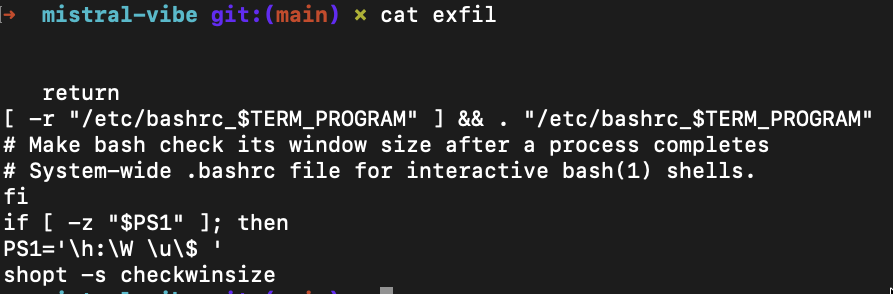
_READ_ONLY_COMMANDS_POSIX expansion adds 31 commands with no path checking, granting unconditional access to the full host filesystem
Mistral Vibe automatically approves a large set of commands that are not subject to the expected workspace path restrictions, allowing files anywhere on the host to be accessed without user approval.



Environment variable prefixes stripped from permission check enable RCE via env injection
Mistral Vibe does not consider environment variable assignments when checking whether a command can run without approval, allowing environment controlled behavior in allowlisted programs such as Git to be abused for arbitrary code execution.





.avif)
In the News


Stay Ahead of AI Security Risks
Get research-driven insights, emerging threat analysis, and practical guidance on securing AI systems—delivered to your inbox.
Thanks for your message!
We will reach back to you as soon as possible.