



Summary
HiddenLayer researchers identified an issue in ChatGPT Sites that exposed account identifiers generated from email addresses through publicly accessible Certificate Transparency (CT) logs. The issue affected users who signed in using OAuth, including those whose Sites were configured as private. OpenAI fixed the vulnerability during the week of October 12, 2026. However, previously issued certificates remain in historical CT logs, meaning all affected users' identifiers may still be publicly accessible.
Introduction
HiddenLayer identified an issue in ChatGPT Sites where some accounts authenticated through OAuth were assigned website namespaces derived from their email addresses.
For example, an account using john.smith@gmail.com could receive a namespace such as john-smith.chatgpt.site. These namespaces were included in publicly issued TLS certificates, making them discoverable even when the associated Sites were restricted to their owners.
While the vulnerability did not directly expose complete email addresses, credentials, or private Site content, the identifiers could potentially be used to infer email addresses or correlate online identities.
Details
How Certificate Transparency Logs Exposed the Identifiers
Certificate Transparency (CT) logs are public records of TLS certificates issued for websites. They help improve internet security by allowing certificate issuance to be independently monitored and audited. When ChatGPT Sites issued certificates for account-specific domains, the account namespaces were recorded in these logs. For affected accounts, those namespaces could contain information derived from their email addresses. Because CT logs are publicly searchable, anyone could retrieve these identifiers without having access to the associated ChatGPT account or Site.
Fix and Remaining Exposure
OpenAI addressed the vulnerability during the week of October 12, 2026, preventing the issue from continuing to affect newly generated namespaces. However, CT logs are designed to retain historical certificate records. Certificates issued before the fix therefore remain discoverable, even if the corresponding ChatGPT Site has since been deleted.
Users who created ChatGPT Sites before the fix may consequently still have email-derived identifiers present in public CT records. Although this exposure does not directly reveal full email addresses, the information could be used to construct candidate email addresses or assist with identity correlation and targeted phishing.
HiddenLayer responsibly disclosed the vulnerability to OpenAI. This advisory is intended to raise awareness of the potential historical exposure, despite the underlying issue having been fixed.
How to Verify if You Are Affected
Users who created a ChatGPT Site before the fix can check whether an identifier derived from their email address appears in public Certificate Transparency (CT) logs.
To do this, construct a potential Site namespace using the portion of your email address before the @ symbol, replacing periods (.) with hyphens (-). For example, an email address such as john.smith@gmail.com could correspond to the namespace john-smith.chatgpt.site.
You can then search for this domain using a public CT log search service such as crt.sh. If the domain appears in the results, it indicates that a certificate containing that namespace was publicly recorded.
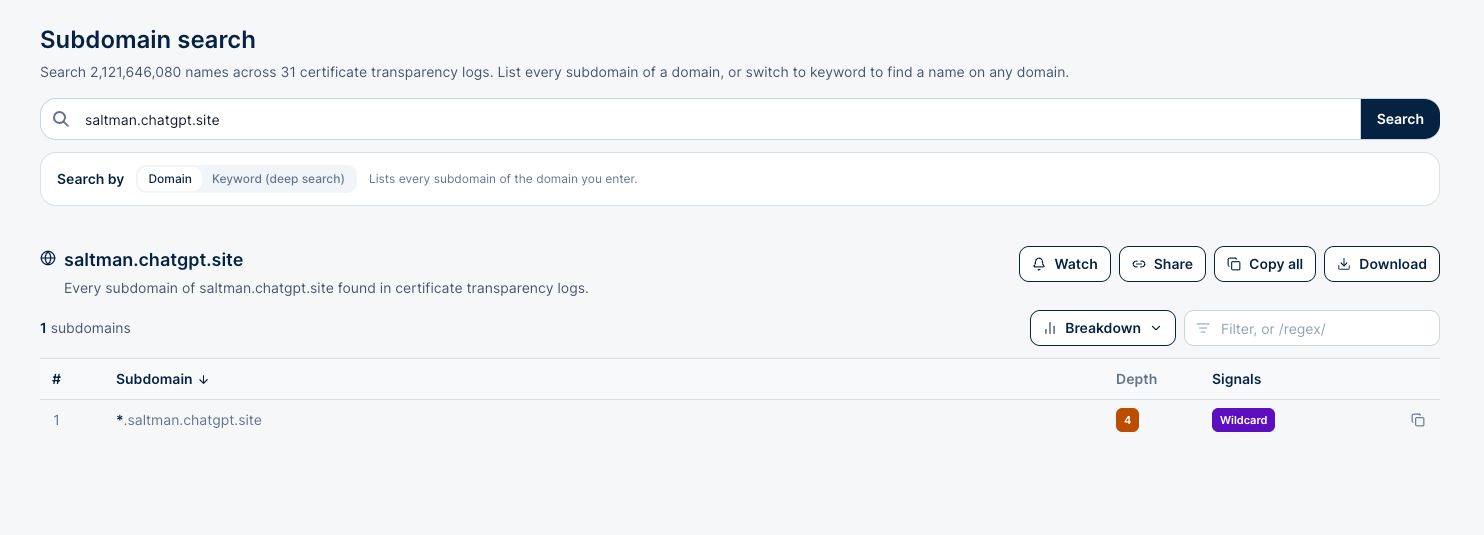
The following screenshot shows an example in which the namespace saltman.chatgpt.site appears in publicly accessible CT records.
Related Research


Malware Found in Trending Hugging Face Repository "Open-OSS/privacy-filter"
On May 7th, 2025, we identified malicious code in the Hugging Face repository Open-OSS/privacy-filter, which is currently among the platform's top trending repositories, with over 200k downloads in the past day.


Stay Ahead of AI Security Risks
Get research-driven insights, emerging threat analysis, and practical guidance on securing AI systems—delivered to your inbox.