Netron Vulnerability Report
August 27, 2026
1-click DOM XSS via Unsanitized innerHTML
CVE Number
CVE-2026-79718
CVE-2026-79719
CVE-2026-79720
Summary
Netron renders user-controlled model fields without HTML escaping. An attacker can craft a malicious model file (any format supported by Netron) that injects arbitrary HTML into the Netron sidebar. In the desktop application, this allows an attacker to make unrestricted HTTP requests to local network services. Furthermore, as the desktop app ships a pinned Chromium version (Electron 42.3.3 / Chrome 148), known n-day V8 vulnerabilities in that renderer could be chained with this primitive to achieve full RCE on the system.
Products Impacted
All Netron releases are affected up to version 9.1.2 included.
A patch is implemented and available starting version 9.1.3 (commit)
CVSS Score: 6.8
CVSS:4.0/AV:L/AC:L/AT:N/PR:N/UI:P/VC:H/VI:N/VA:N/SC:L/SI:N/SA:N
CWE Categorization
CWE-79: Improper Neutralization of Input During Web Page Generation (Cross-site Scripting)
Details
Netron uses the escape() helper correctly throughout the file. There are, however, three places where user-controlled model fields are written directly into innerHTML:
const name = this._node.name;
const element = this.createElement('div', 'sidebar-item-value-line-border');
element.innerHTML = `<span class='sidebar-item-value-line-content'>name: <b>${name}</b></span>`;const description = this._argument.description;
if (description) {
const line = this.createElement('div', 'sidebar-item-value-line-border');
line.innerHTML = description;const description = this._value.description;
if (description) {
const line = this.createElement('div', 'sidebar-item-value-line-border');
line.innerHTML = description;All three fire when the user clicks a node to open the sidebar. Setting any of these fields to an HTML string in a crafted ONNX file causes the browser to parse and render it.
Netron has a Content-Security-Policy (CSP) as an additional safety measure. It is set to script-src 'self'. This blocks inline <script> tags and external scripts, but there is no frame-src directive. An <iframe> pointing at a cross-origin URL is permitted. The framed page is of a different origin, so it does not inherit the parent CSP, and as such, scripts inside it execute freely.
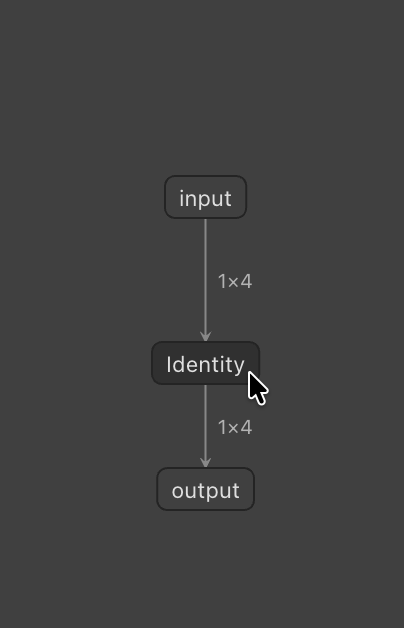
Inside of Netron, simply selecting the Identity node will trigger the XSS:
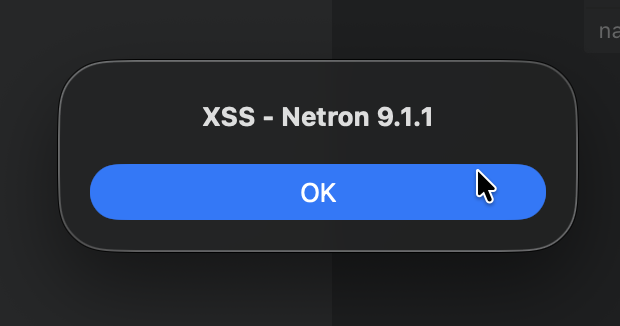
When the node is selected, pop up like this will appear:
The impact of executing arbitrary JavaScript in this context can seem relatively low because Netron has no cookies, no accounts, or anything to steal. However, there are three clear impacts:
- An attacker can hide certain nodes from the UI, effectively hiding a backdoor
- An attacker can perform port scanning
- An attacker can abuse V8 renderer n-days targeting the release (Chrome 148.0.7778.218) that could be chained with this XSS to escape the renderer sandbox and achieve full RCE on the host
Project URL:
https://github.com/lutzroeder/netron.git
RESEARCHER: Esteban Tonglet, Security Researcher, HiddenLayer
Related SAI Security Advisory
September 11, 2026
_READ_ONLY_COMMANDS_POSIX expansion adds 31 commands with no path checking, granting unconditional access to the full host filesystem
Mistral Vibe automatically approves a large set of commands that are not subject to the expected workspace path restrictions, allowing files anywhere on the host to be accessed without user approval.
September 11, 2026
Environment variable prefixes stripped from permission check enable RCE via env injection
Mistral Vibe does not consider environment variable assignments when checking whether a command can run without approval, allowing environment controlled behavior in allowlisted programs such as Git to be abused for arbitrary code execution.