
HiddenLayer in the News
See how our research, leadership, and innovations are shaping the global conversation on AI security.

min read
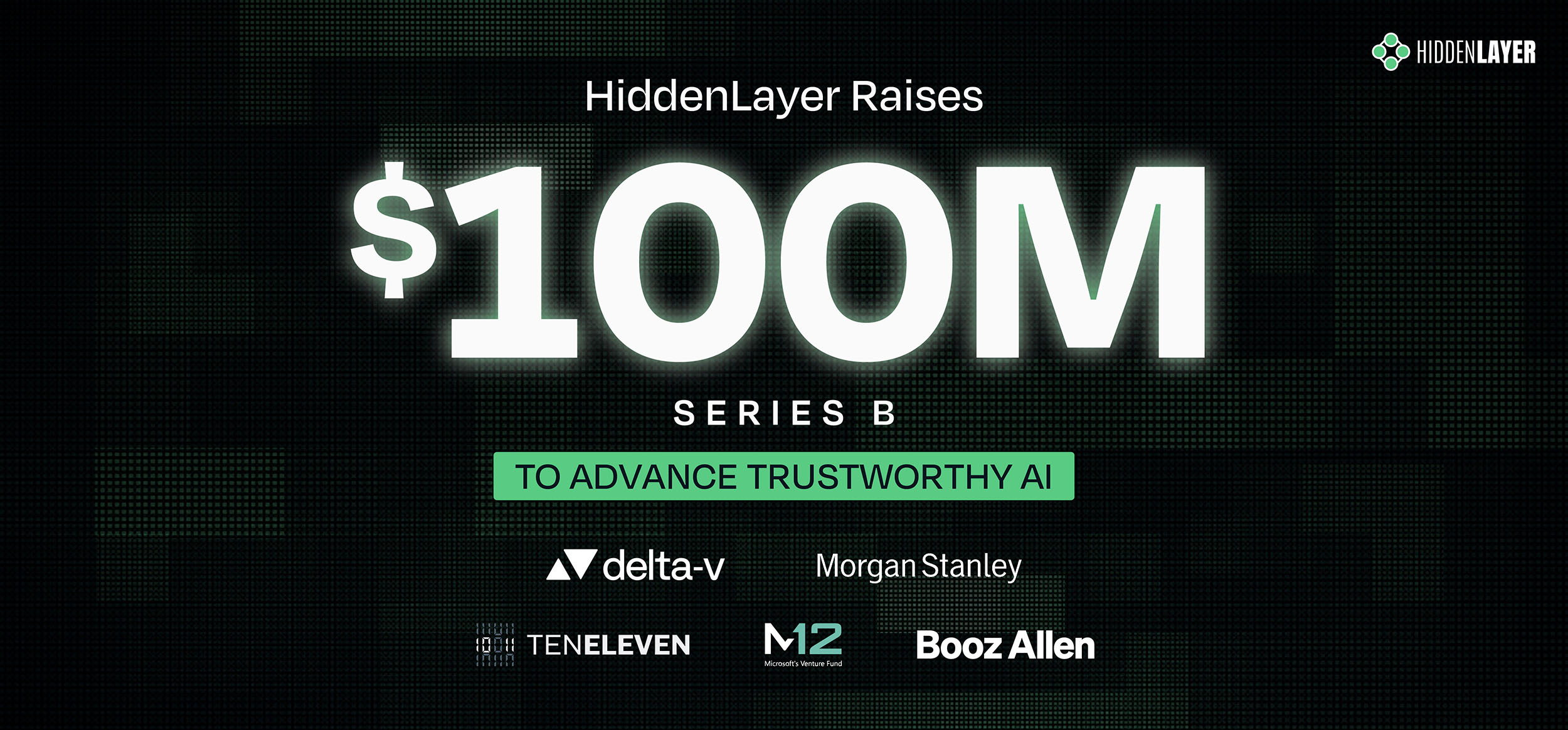
HiddenLayer Raises $100M Series B to Advance Trustworthy AI
HiddenLayer raises $100M in Series B funding to advance AI security, expand agentic runtime protection, and meet growing enterprise demand.
The investment comes as enterprises race to secure a rapidly expanding AI attack surface, from foundation models to the autonomous agents now writing and shipping code on their behalf.
September 2, 2026 – Austin, TX – HiddenLayer, the leading AI security company that secures agentic, generative, and predictive AI applications, today announced a $100 million Series B funding round led by Delta-v Capital, with participation from Ten Eleven Ventures, Morgan Stanley, M12, Microsoft's Venture Fund, and Booz Allen Ventures.
The company will use the funding to deepen its enterprise platform, including its Agentic Runtime Security capabilities, and Agent Harness Security, a new solution that extends the Runtime Security module to secure AI coding agents at runtime and protect enterprises adopting autonomous coding agents into their stack.
"We set out to pioneer trusted, secure use of AI for enterprises, long before most organizations saw the urgency we do today. This funding lets us keep growing the purpose-built team and platform required to meet that moment as agentic AI becomes core to how enterprises operate,” said Chris Sestito, CEO and Co-Founder of HiddenLayer.
The raise follows a standout year: HiddenLayer's annual recurring revenue grew more than 10x, and the company signed more than 50 new platform customers, including some of the largest names in securities brokerage, banking, insurance, accounting, government, technology, IT services, pharmaceuticals, airlines, and the US defense and intelligence communities. Internationally, new customers included one of the world's largest pharmaceutical companies, along with several premium automotive brands and food and beverage providers. HiddenLayer also supports a leading frontier model provider in securing more than 700 million weekly users.
This growth is underpinned by a world-class research team that has directly influenced how leading organizations protect their AI systems. HiddenLayer's researchers hold 39 granted patents and 65 pending patents spanning adversarial detection, model protection, and AI threat analysis. The team developed the first comprehensive Adversarial Prompt Engineering (APE) Taxonomy and continues to research emerging threats across generative, predictive, and agentic AI, identifying dozens of vulnerabilities across the AI ecosystem, from foundation models to the tools and infrastructure that support them. HiddenLayer's researchers also contribute to the broader AI security community through work with organizations and initiatives including CISA/JCDC, MITRE, NIST, OWASP, and OpenSSF, improving red teaming methodologies and informing global discussions on AI governance and safety.
"Traditional security tools were built for code and infrastructure, not for models that can be poisoned, hijacked, or manipulated through their own inputs,” said Dan Williams, Partner at Delta-v Capital. "HiddenLayer built a platform from the ground up to secure AI across its full lifecycle, from the model at its core to the agentic systems being layered on top and whatever architecture comes next. We’ve watched this team turn deep adversarial-AI research into a product CISOs actually rely on, and we're proud to partner with them."
The funding allows HiddenLayer to focus on the three fronts where enterprises are most exposed: Agentic Runtime Security, giving organizations visibility into how their AI agents behave in production, flagging and stopping manipulation, tool misuse, and unauthorized actions as they happen, and securing Agentic Harnesses and Autonomous Coding Agents that write, review, and ship code with much less human oversight than traditional development tools. As AI cannot be made trustworthy through design-time principles alone, there is no trustworthy AI without end-to-end AI-native security. Trust has to be continuously tested and proven at runtime. These capabilities are designed to give enterprises the confidence to trust their AI, with 96% of organizations already considering AI critical to their core operations, but nearly a third unable to say with certainty whether they've experienced an AI-related breach, according to HiddenLayer’s 2026 AI Threat Landscape Report.
“Enterprises don't shift budgets at this pace unless a problem is urgent. HiddenLayer's growth over the past year across defense, financial services, and some of the most sensitive AI deployments in the world demonstrates that security teams have concluded that AI needs its own category of protection,” said Mark Hatfield, Co-Founder and Partner at Ten Eleven Ventures. “We expect that conviction to continue to grow as autonomous systems become more and more integral to the enterprise."
“HiddenLayer was early to recognize that enterprise security is critical to the safe deployment of AI, and its buildout of an end-to-end platform to enable compliant AI adoption is an important contribution to addressing this market need,” said Zheng Wang, Head of Strategic Investments at Morgan Stanley. “We are delighted to be investing in HiddenLayer to foster its next phase of growth and innovation.”
HiddenLayer is also strengthening its leadership team, recently naming Mike Gesnaldo as Chief Revenue Officer. More hires are on the way as the company deepens its channel relationships, keeps pace with enterprise customer demand, and pushes further into international markets, beginning with Europe and the wider EMEA region.
About HiddenLayer
HiddenLayer secures agentic, generative, and predictive AI applications across the entire AI lifecycle, from discovery and AI supply chain security to attack simulation and runtime protection. Backed by patented technology and industry-leading adversarial AI research, our platform is purpose-built to defend AI systems against evolving threats. HiddenLayer protects intellectual property, helps ensure regulatory compliance, and enables organizations to safely adopt and scale AI with confidence.
About Delta-v Capital
Delta-v Capital (“Delta-v”) partners with visionary leaders of technology companies to accelerate their next phase of growth. Delta-v is a sector-focused investor with expertise in infrastructure software, cloud services, vertical software, and digital infrastructure. The firm provides flexible growth capital to support organic growth, strategic acquisitions, and shareholder liquidity, partnering with management teams and existing investors as companies scale. Delta-v currently manages over $1.6B in assets on behalf of institutional and individual investors. For more information, please visit www.deltavcapital.com or follow Delta-v Capital on LinkedIn.
Contact
SutherlandGold for HiddenLayer
hiddenlayer@sutherlandgold.com

min read
HiddenLayer Adds AI Detection & Response for Generative AI
HiddenLayer, the leading security provider for artificial intelligence (AI) models and assets, today announced the launch of its latest product: AI Detection & Response for Generative AI. The new capability comes as part of HiddenLayer’s award-winning platform, formerly known as MLDR, extending HiddenLayer’s end-to-end security to organizations deploying LLM-based applications.
Expanding AISec Platform to Facilitate Adoption of LLMs with Enterprise-Grade Security
AUSTIN, Texas - March 19, 2024 - HiddenLayer, the leading security provider for artificial intelligence (AI) models and assets, today announced the launch of its latest product: AI Detection & Response for Generative AI. The new capability comes as part of HiddenLayer’s award-winning platform, formerly known as MLDR, extending HiddenLayer’s end-to-end security to organizations deploying LLM-based applications.
HiddenLayer's AI Detection & Response for Generative AI provides a set of security controls that enable real-time monitoring, detection, and response to threats specific to LLMs. The system supports a majority of LLMs, including GPT-X, LlaMa, Mistral, and internally built LLMs out-of-the-box, and allows for the interception of traffic to and from LLM applications, offering the capability to block harmful transactions or generate alerts for security teams to take necessary actions. This ensures that LLM deployments can be managed securely, mitigating the risk of data leaks, malicious use, and other abuses.
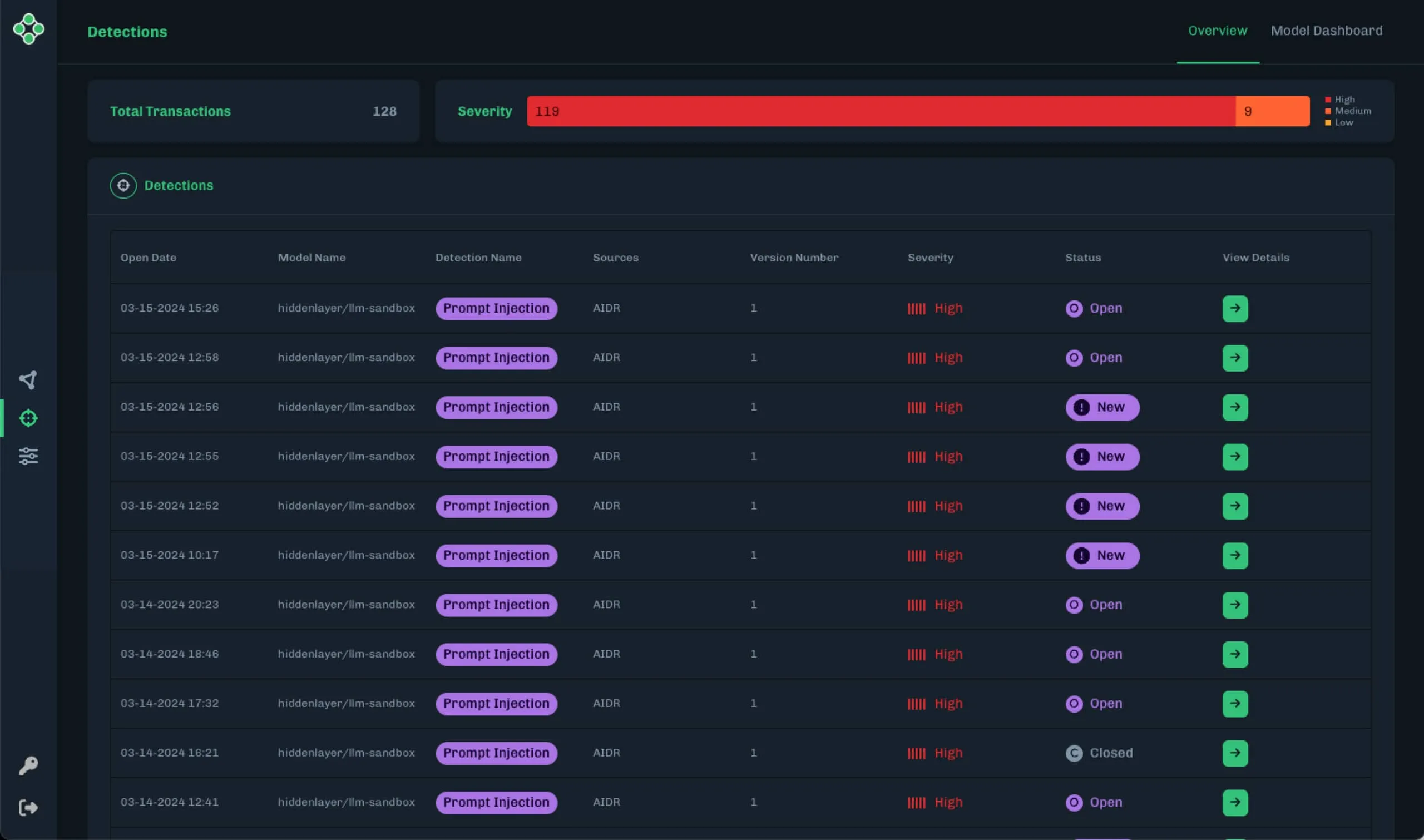
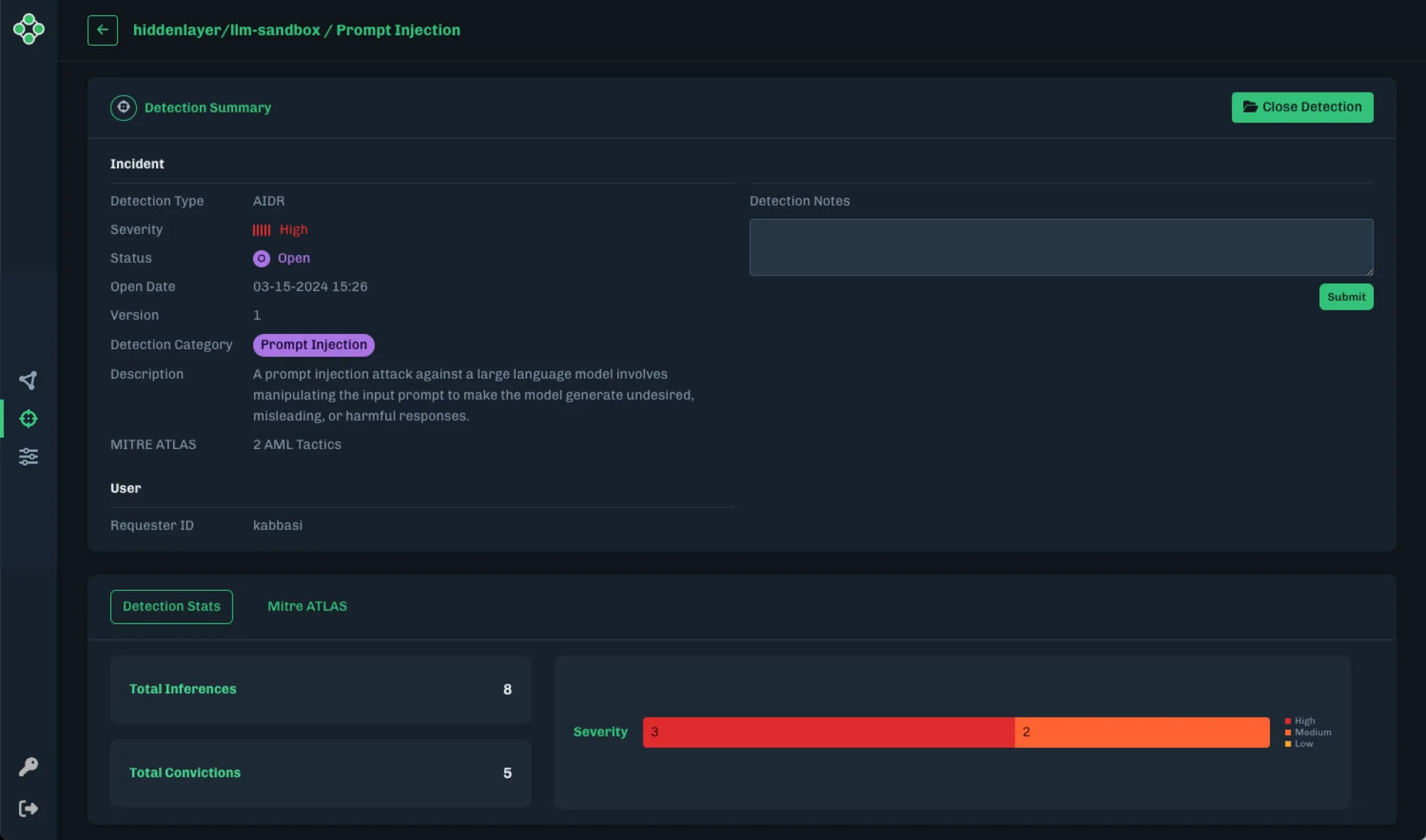
“HiddenLayer's AI Detection & Response allows organizations to responsibly navigate the risks associated with Generative AI, facilitating safe adoption of AI across industries,” said Chris "Tito" Sestito, Co-Founder and CEO of HiddenLayer. “By empowering CISOs and security leaders to bring Generative AI technologies to their organizations with responsible controls, this launch stands as the latest step in our mission to help enterprises protect their most valuable technology.”
The launch comes on the heels of the release of HiddenLayer’s AI Threat Landscape Report, which found that AI adoption continues to accelerate without proper security measures. With 98% of surveyed companies considering at least some of their AI models crucial to their business success, and 77% identifying breaches to their AI in the past year, the need to protect and secure all forms of AI is clear.
HiddenLayer’s AI Detection & Response fortifies organizations’ generative AI deployments against unauthorized access, infiltration attempts, and intellectual property theft - all while delivering real-time protection. The platform is automated, enabling it to recognize real-time attacks and respond to generative AI model breach attempts with speed, and can be easily deployed and integrated into existing MLOps frameworks and security tools in minutes, not days. Furthermore, the platform is scalable, providing clear reporting on detected threats, empowering security teams with insights into adversarial behavior.
Organizations leveraging HiddenLayer’s AI Detection & Response will see the following outcomes:
- Immediate and continuous real-time protection against cyber threats as outlined in 3rd party frameworks, including MITRE ATLAS and LLM OWASP.
- Unleashed innovation, enabling the quick deployment of models into production, while proactively mitigating cybersecurity risks in real-time as part of the MLOps Lifecycle, ensuring a secure and efficient workflow.
- Assistance in maintaining compliance as safeguards against threats that could result in regulatory issues.
- An organization empowered to safely and securely embrace modernization through the transformative capabilities of generative AI.
Learn more about HiddenLayer’s AI Detection & Response for Generative AI capability here.
About HiddenLayer
HiddenLayer is the leading provider of security for AI. Its security platform helps enterprises safeguard the machine learning models behind their most important products. HiddenLayer is the only company to offer turnkey security for AI that does not add unnecessary complexity to models and does not require access to raw data and algorithms. Founded by a team with deep roots in security and ML, HiddenLayer aims to protect enterprise’s AI from inference, bypass, extraction attacks, and model theft. The company is backed by a group of strategic investors, including M12, Microsoft's Venture Fund, Booz Allen Ventures, IBM Ventures, and Capital One Ventures.
Contact
David Sack
SutherlandGold for HiddenLayer
hiddenlayer@sutherlandgold.com
min read
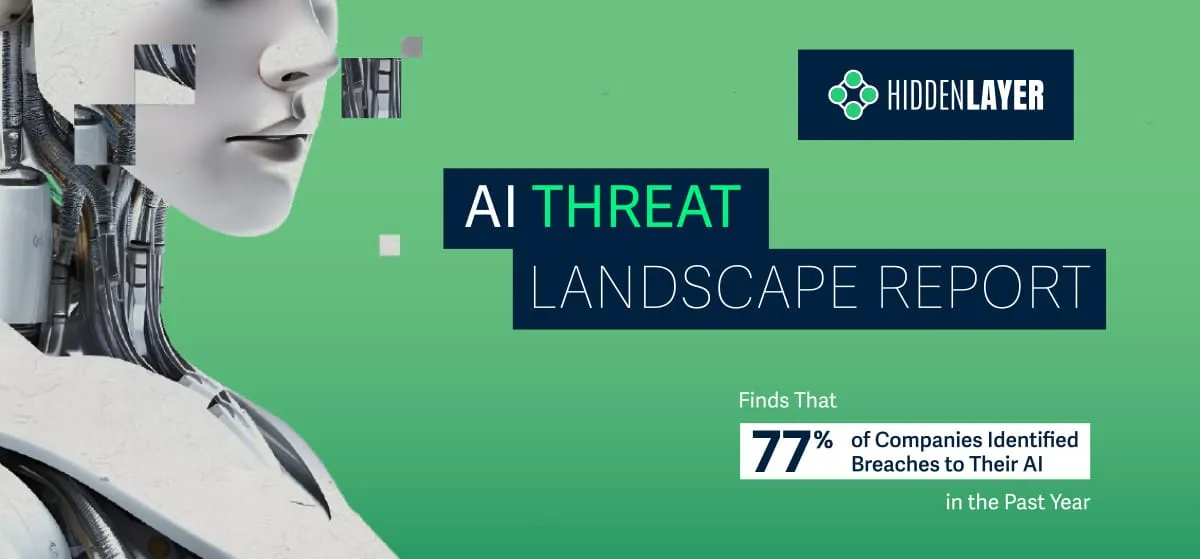
HiddenLayer AI Threat Landscape Report Finds That 77% of Companies Identified Breaches to Their AI in the Past Year
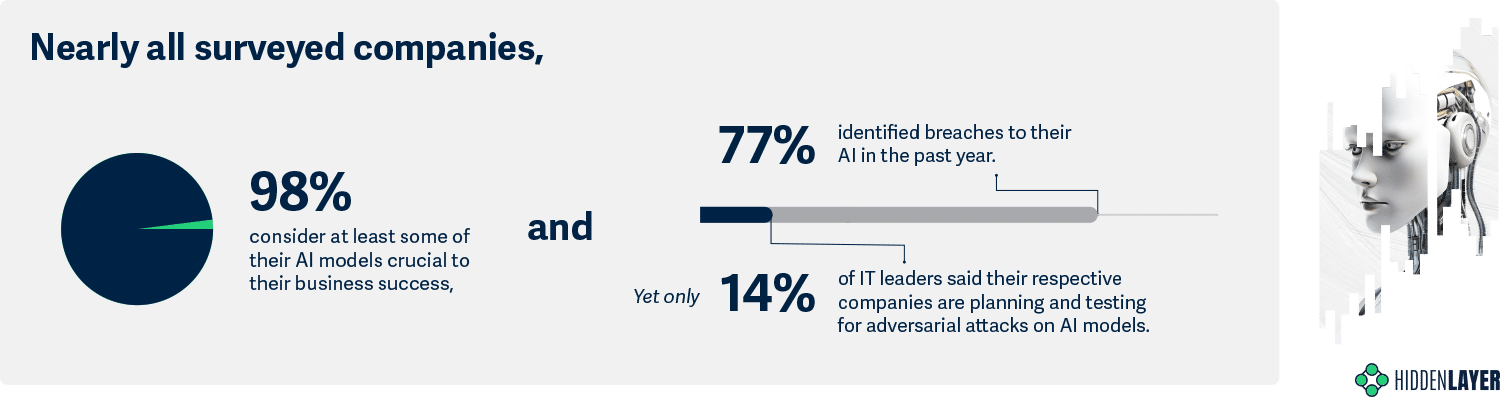
HiddenLayer, the leading security provider for artificial intelligence (AI) models and assets, today released its inaugural AI Threat Landscape Report highlighting the pervasive use of AI and the risks involved in its deployment. Nearly all surveyed companies, 98%, consider at least some of their AI models crucial to their business success, and 77% identified breaches to their AI in the past year. Yet only 14% of IT leaders said their respective companies are planning and testing for adversarial attacks on AI models.
Survey of security leaders shows AI adoption is accelerating without proper security measures
AUSTIN, Texas - March 6, 2024 - HiddenLayer, the leading security provider for artificial intelligence (AI) models and assets, today released its inaugural AI Threat Landscape Report highlighting the pervasive use of AI and the risks involved in its deployment. Nearly all surveyed companies, 98%, consider at least some of their AI models crucial to their business success, and 77% identified breaches to their AI in the past year. Yet only 14% of IT leaders said their respective companies are planning and testing for adversarial attacks on AI models.
The report surveyed 150 IT security and data science leaders to shed light on the biggest vulnerabilities impacting AI today, their implications on commercial and federal organizations, and cutting-edge advancements in security controls for AI in all its forms.
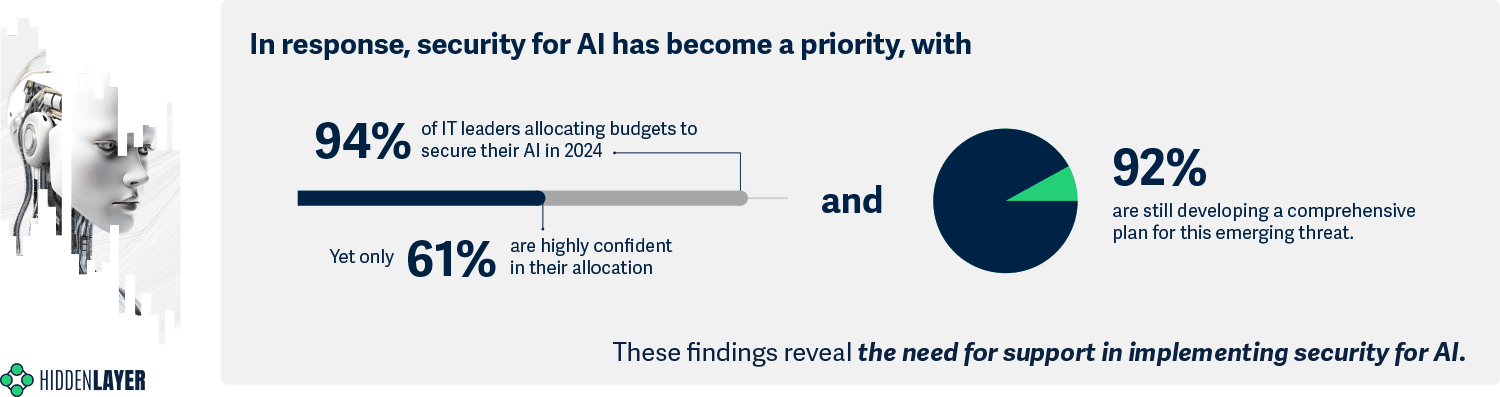
The survey uncovered AI’s widespread utilization by today’s businesses as companies have, on average, a staggering 1,689 AI models in production. In response, security for AI has become a priority, with 94% of IT leaders allocating budgets to secure their AI in 2024. Yet only 61% are highly confident in their allocation, and 92% are still developing a comprehensive plan for this emerging threat. These findings reveal the need for support in implementing security for AI.
“AI is the most vulnerable technology ever to be deployed in production systems,” said Chris "Tito" Sestito, Co-Founder and CEO of HiddenLayer. “The rapid emergence of AI has resulted in an unprecedented technological revolution, of which every organization in the world is affected. Our first-ever AI Threat Landscape Report reveals the breadth of risks to the world’s most important technology. HiddenLayer is proud to be on the front lines of research and guidance around these threats to help organizations navigate the security for AI landscape.”
Risks Involved with AI Use
Adversaries can leverage a variety of methods to utilize AI to their advantage. The most common risks of AI usage include:
- Manipulation to give biased, inaccurate, or harmful information.
- Creation of harmful content, such as malware, phishing, and propaganda.
- Development of deep fake images, audio, and video.
- Leveraged by malicious actors to provide access to dangerous or illegal information.
Common Types of Attacks on AI
There are three major types of attacks on AI:
- Adversarial Machine Learning Attacks target AI algorithms, aimed to alter AI’s behavior, evade AI-based detection, or steal the underlying technology.
- Generative AI System Attacks threaten AI’s filters and restrictions, intended to generate content deemed harmful or illegal.
- Supply Chain Attacks attack ML artifacts and platforms with the intention of arbitrary code execution and delivery of traditional malware.
Challenges to Securing AI
While industries are reaping the benefits of increased efficiency and innovation thanks to AI, many organizations do not have proper security measures in place to ensure safe use. Some of the biggest challenges reported by organizations in securing their AI include:
- Shadow IT: 61% of IT leaders acknowledge shadow AI, solutions that are not officially known or under the control of the IT department, as a problem within their organizations.
- Third-Party AIs: 89% express concern about security vulnerabilities associated with integrating third-party AIs, and 75% believe third-party AI integrations pose a greater risk than existing threats.
Best Practices for Securing AI
HiddenLayer has outlined recommendations for organizations to begin securing their AI, including:
- Discovery and Asset Management: Begin by identifying where AI is already used in your organization. What applications has your organization already purchased that use AI or have AI-enabled features?
- Risk Assessment and Threat Modeling: Perform threat modeling to understand the potential vulnerabilities and attack vectors that could be exploited by malicious actors to complete your understanding of your organization’s AI risk exposure.
- Data Security and Privacy: Go beyond the typical implementation of encryption, access controls, and secure data storage practices to protect your AI model data. Evaluate and implement security solutions that are purpose-built to provide runtime protection for AI models.
- Model Robustness and Validation: Regularly assess the robustness of AI models against adversarial attacks. This involves pen-testing the model's response to various attacks, such as intentionally manipulated inputs.
- Secure Development Practices: Incorporate security into your AI development lifecycle. Train your data scientists, data engineers, and developers on the various attack vectors associated with AI.
- Continuous Monitoring and Incident Response: Implement continuous monitoring mechanisms to detect anomalies and potential security incidents in real-time for your AI, and develop a robust AI incident response plan to quickly and effectively address security breaches or anomalies.
HiddenLayer’s products and services accelerate the process of securing AI, with its AISec Platform providing a comprehensive AI security solution that ensures the integrity and safety of models throughout an organization's MLOps pipeline. HiddenLayer also provides its Machine Learning Detection & Response (MLDR), which enables organizations to automate and scale the protection of AI models and ensure their security in real-time, and its Model Scanner, which enables companies to evaluate the security and integrity of their ML artifacts before deploying them.
For more information, view the full 2024 Report.
About HiddenLayer
HiddenLayer is the leading provider of security for AI. Its security platform helps enterprises safeguard the machine learning models behind their most important products. HiddenLayer is the only company to offer turnkey security for AI that does not add unnecessary complexity to models and does not require access to raw data and algorithms. Founded by a team with deep roots in security and ML, HiddenLayer aims to protect enterprise’s AI from inference, bypass, extraction attacks, and model theft. The company is backed by a group of strategic investors, including M12, Microsoft's Venture Fund, Booz Allen Ventures, IBM Ventures, and Capital One Ventures.
Contact
David Sack
SutherlandGold for HiddenLayer
hiddenlayer@sutherlandgold.com


min read
HiddenLayer with OpenPolicy Announces Participation in the Department of Commerce Consortium Dedicated to AI Safety
HiddenLayer, the leading security provider for artificial intelligence (AI) models and assets, announced that via the OpenPolicy AI Coalition, it joins in the participation of more than 200 of the nation’s leading artificial intelligence (AI) stakeholders to participate in a Department of Commerce initiative to support the development and deployment of trustworthy and safe AI. Established by the Department of Commerce’s National Institute of Standards and Technology (NIST), the U.S. AI Safety Institute Consortium (AISIC) will bring together AI creators and users, academics, government and industry researchers, and civil society organizations to meet this mission.
HiddenLayer, alongside OpenPolicy AI Coalition members, is excited to partner with the NIST U.S. AI Safety Institute Consortium (AISIC).
AUSTIN, Texas - February 8, 2024 - Today HiddenLayer, the leading security provider for artificial intelligence (AI) models and assets, announced that via the OpenPolicy AI Coalition, it joins in the participation of more than 200 of the nation’s leading artificial intelligence (AI) stakeholders to participate in a Department of Commerce initiative to support the development and deployment of trustworthy and safe AI. Established by the Department of Commerce’s National Institute of Standards and Technology (NIST), the U.S. AI Safety Institute Consortium (AISIC) will bring together AI creators and users, academics, government and industry researchers, and civil society organizations to meet this mission.
“We proudly join the NIST Artificial Intelligence Safety Institute Consortium alongside a coalition of AI innovators brought together by OpenPolicy, supporting the trusted deployment of AI and advancing the administration’s policy goals,” said Chris Sestito, CEO & Co-Founder, HiddenLayer. “Our mission to provide the most comprehensive security solution for AI is rooted in our commitment to protect government, industry, and society at large from all emerging AI threats.”
“OpenPolicy and its coalition of innovative AI companies are honored to take part in AISIC. The launch of the U.S. Artificial Intelligence Safety Institute is a necessary step forward in ensuring the trusted deployment of AI, and achieving the administration’s AI policy goals,” said Dr. Amit Elazari, CEO and Co-Founder, OpenPolicy. “Supporting the trusted deployment and development of AI entails supporting the development of cutting-edge innovative solutions needed to protect government, industry, and society from emerging AI threats. Innovative companies stand at the forefront of developing leading security, safety, and trustworthy AI and privacy solutions, and these are the communities we represent. Our AI coalition is committed to supporting the U.S. government and implementing agencies in this effort and will provide research, frameworks, benchmarks, policy support, and tooling to advance the trusted deployment and development of AI.”
“The U.S. government has a significant role to play in setting the standards and developing the tools we need to mitigate the risks and harness the immense potential of artificial intelligence. President Biden directed us to pull every lever to accomplish two key goals: set safety standards and protect our innovation ecosystem. That’s precisely what the U.S. AI Safety Institute Consortium is set up to help us do,” said Secretary Raimondo. “Through President Biden’s landmark Executive Order, we will ensure America is at the front of the pack – and by working with this group of leaders from industry, civil society, and academia, together we can confront these challenges to develop the measurements and standards we need to maintain America’s competitive edge and develop AI responsibly.”
The consortium includes more than 200 member companies and organizations that are on the frontlines of developing and using AI systems, as well as the civil society and academic teams that are building the foundational understanding of how AI can and will transform our society. These entities represent the nation’s largest companies and innovative startups; creators of the world’s most advanced AI systems and hardware; key members of civil society and the academic community; and representatives of professions with deep engagement in AI’s use today. The consortium also includes state and local governments, as well as non-profits. The consortium will also work with organizations from like-minded nations that have a key role to play in setting interoperable and effective safety around the world.
The full list of consortium participants is available here.
About HiddenLayer
HiddenLayer, a Gartner-recognized AI Application Security company, helps enterprises safeguard the machine learning models behind their most important products with a comprehensive security platform. Only HiddenLayer offers turnkey security for AI that does not add unnecessary complexity to models and does not require access to raw data and algorithms. Founded in March of 2022 by experienced security and ML professionals, HiddenLayer is based in Austin, Texas. For additional information, including product updates and the latest research reports, visit www.hiddenlayer.com.
Contacts
Hannah Williams
SutherlandGold for HiddenLayer
hiddenlayer@sutherlandgold.com
min read
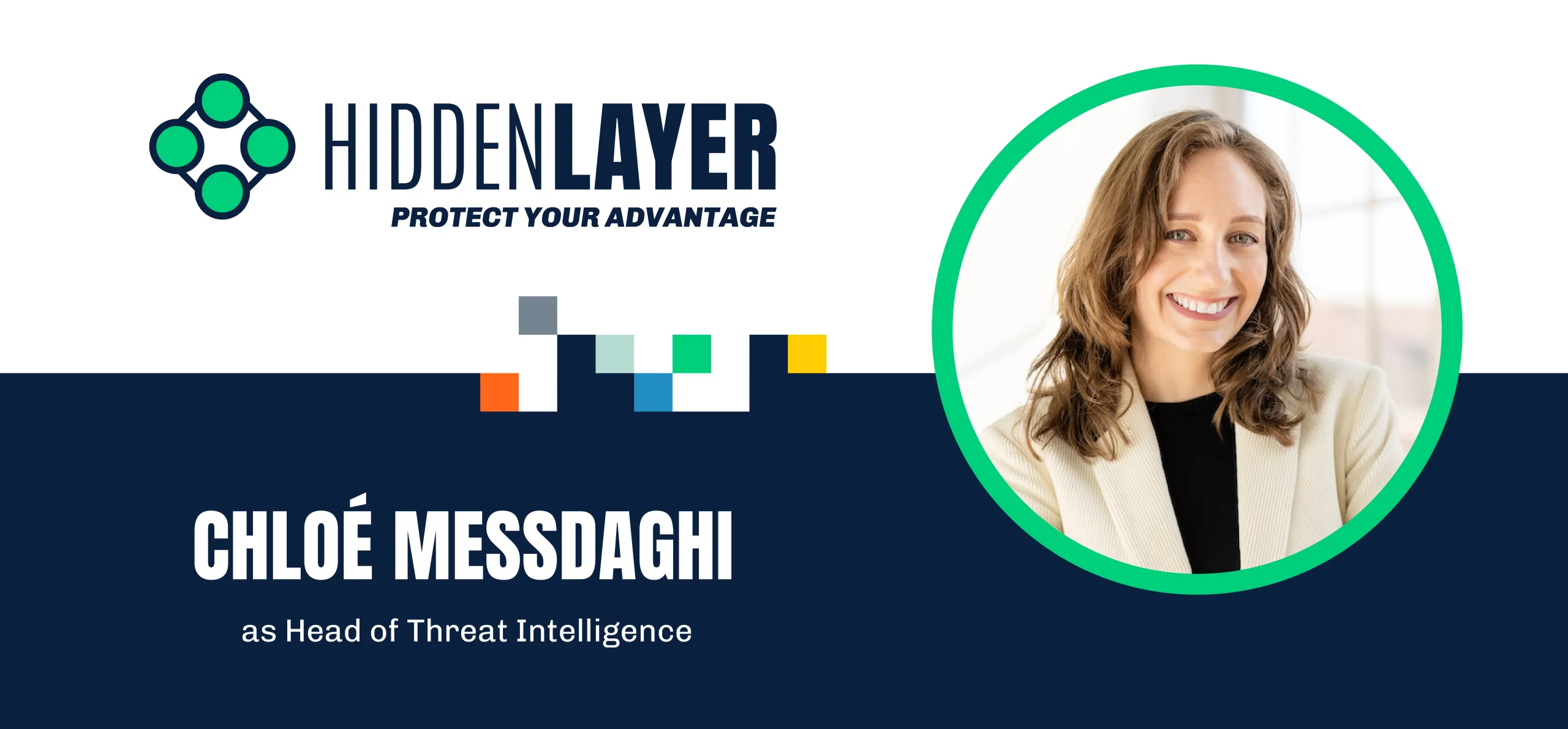
HiddenLayer Appoints Chloé Messdaghi as Head of Threat Intelligence
HiddenLayer, the leading security provider for artificial intelligence (AI) models and assets, has welcomed Chloé Messdaghi as its Head of Threat Intelligence. She is focused on sharing the latest Security for AI research, building bridges between ML developers, Security Researchers, Data Scientists, and the CISO communities, and driving growth of the Security for AI category through education.
Messdaghi Brings Proven Expertise and Diverse Background to Elevate Security Practices
AUSTIN, Texas, Jan. 30, 2024 -- HiddenLayer, the leading security provider for artificial intelligence (AI) models and assets, has welcomed Chloé Messdaghi as its Head of Threat Intelligence. She is focused on sharing the latest Security for AI research, building bridges between ML developers, Security Researchers, Data Scientists, and the CISO communities, and driving growth of the Security for AI category through education.
Messdaghi brings with her a proven track record of advising and developing solutions and strategies that have driven vast improvements in security teams. She has extensive knowledge of the industry, coming from multiple tenures in security-based roles, including within security for AI. With a background in politics, working for the Office of Governor Arnold Schwarzenegger, and as a volunteer for the United Nations, Messdaghi brings a unique perspective to the job.
"We are thrilled to bring Chloé on to drive growth not only for HiddenLayer but the category as a whole," said Chris Sestito, Co-Founder and Chief Executive Officer at HiddenLayer. “Her ability to tap into the MLOps community and drive growth will be invaluable to the HiddenLayer mission.”
Messdaghi has won numerous awards during her career, including Cybersecurity Woman of the Year, Cybersecurity Advocate of the Year, and has been named a Power Player in the Cybersecurity industry by both SC Media's Women in IT Security and Business Insider. She serves as a board member for The Diana Initiative and is an Advisory Board Member for the Election Security Research Forum.
"I am incredibly excited to join HiddenLayer and expand my ability to truly impact the security for AI category," said Messdaghi. "With this new role, I will be able to accelerate AI/ML adoption in a proactive and sustainable way by interacting with the communities at every stage of the ML Ops Lifecycle.”
Her research, op-eds, and commentary have been featured in numerous outlets, including Forbes, Business Insider, Bloomberg, and TechRepublic. She holds a bachelor's degree in international relations from the University of California at Davis and a MSc in Politics from the University of Edinburgh.
About HiddenLayer
HiddenLayer, a Gartner-recognized AI Application Security company, helps enterprises safeguard the machine learning models behind their most important products with a comprehensive security platform. Only HiddenLayer offers turnkey security for AI that does not add unnecessary complexity to models and does not require access to raw data and algorithms. Founded in March of 2022 by experienced security and ML professionals, HiddenLayer is based in Austin, Texas. For additional information, including product updates and the latest research reports, visit www.hiddenlayer.com.
Contacts
Hannah Williams
SutherlandGold for HiddenLayer
hiddenlayer@sutherlandgold.com
min read
HiddenLayer Launches Channel Partner Program to Secure AI and MLOps Lifecycle
HiddenLayer, the leading security provider for artificial intelligence (AI) models and assets, today announced a new partner program to empower enterprises with complete AI protection including rapid threat detection and security across the entire MLOps lifecycle.
HiddenLayer bolsters its offerings after earning a spot on the CRN® 2023 Stellar Startups List
AUSTIN, Texas - January 23, 2024 - HiddenLayer, the leading security provider for artificial intelligence (AI) models and assets, today announced a new partner program to empower enterprises with complete AI protection including rapid threat detection and security across the entire MLOps lifecycle.
“Our Channel Partner Program is designed to drive innovation by allowing partners to introduce security for AI to their customers, helping to educate more businesses about a new threat landscape,” said Rebecca Cahak, Head of Channel, HiddenLayer. “By leveraging this new offering, partners will ensure margin and deal protection, leverage incentives, access flexible and easy-to-use training tools, demo environments, and proof of value tools to drive success.”
The Channel Partner Program allows partners to seamlessly onboard while providing predictable, transparent pricing and flexible licensing models, and a first-of-its-kind unobtrusive, automated, scalable Artificial Intelligence Security (AISec) Platform. Partners will be able to educate customers on a new threat landscape and provide the solutions they need to protect their AI, and competitive edge, build stronger relationships, and establish their team as AI leaders for their customers.
"The HiddenLayer line of products is an important component in our AI security service offerings,” said Matt Keating, Head of AI Security at Booz Allen Hamilton. “We are excited to continue to strengthen our strategic partnership with the HiddenLayer team, furthering our ability for joint strategy and co-solutioning.”
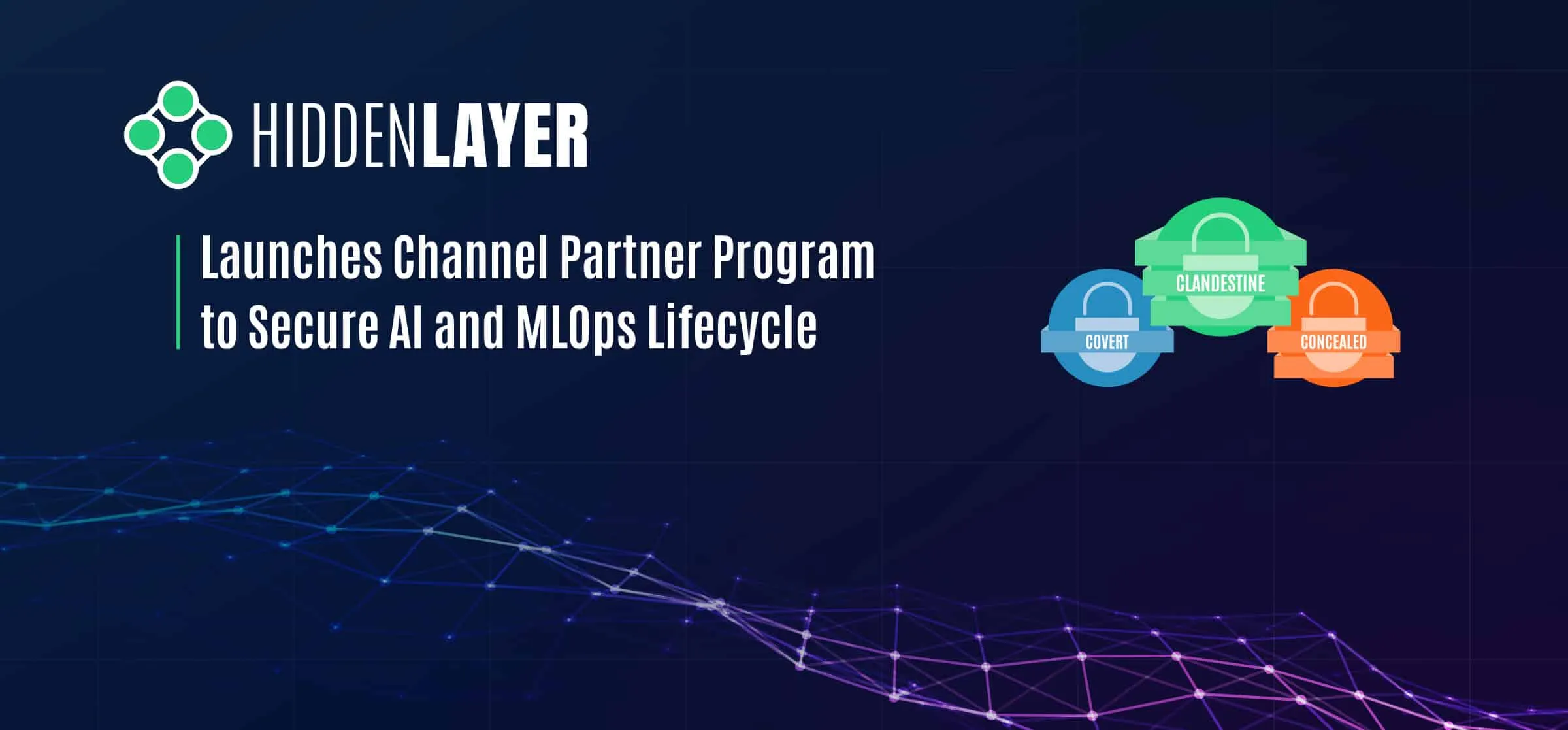
HiddenLayer aims to optimize its current partner network, enhancing it through streamlined support and collaborative offerings. There will be three tiers for the program, Covert, Concealed, and Clandestine, so customers can work together with HiddenLayer to achieve the best-shared outcome. Each tier includes pricing discounts, free online training for sales, and technical enablement and security for AI marketing partnerships. Concealed includes free on-site training and performance incentive programs for extra financial success. Clandestine includes everything previously mentioned, with the addition of account mapping, executive security research briefings, and more.
“By joining HiddenLayer’s partner program, we’re enabling customers to safeguard against constantly evolving cybersecurity risks,” said Rick Echevarria, Vice President and General Manager, Intel Security Center of Excellence. “We are now able to provide a scalable security solution for AI and help more businesses foster the acceleration of safer AI adoption.”
Additionally, HiddenLayer recently announced that CRN®, a brand of The Channel Company, named HiddenLayer to its 2023 Stellar Startups list. This annual list, previously known as CRN Emerging Vendors, recognizes fast-rising technology manufacturers committed to delivering leading-edge solutions that propel innovation and growth in the IT channel.
Learn more about HiddenLayer’s Channel Partner Program here.
About HiddenLayer
HiddenLayer, a Gartner-recognized AI Application Security company, helps enterprises safeguard the machine learning models behind their most important products with a comprehensive security platform. Only HiddenLayer offers turnkey security for AI that does not add unnecessary complexity to models and does not require access to raw data and algorithms. Founded in March of 2022 by experienced security and ML professionals, HiddenLayer is based in Austin, Texas. For additional information, including product updates and the latest research reports, visit www.hiddenlayer.com.
Contacts
Hannah Williams
SutherlandGold for HiddenLayer
hiddenlayer@sutherlandgold.com

Let’s Secure AI Together
Join HiddenLayer in shaping the standards, defenses, and future of AI security. Whether you’re a researcher, partner, or enterprise innovator, we’re stronger together.