
HiddenLayer in the News
See how our research, leadership, and innovations are shaping the global conversation on AI security.


min read
HiddenLayer Raises $100M Series B to Advance Trustworthy AI
HiddenLayer raises $100M in Series B funding to advance AI security, expand agentic runtime protection, and meet growing enterprise demand.
The investment comes as enterprises race to secure a rapidly expanding AI attack surface, from foundation models to the autonomous agents now writing and shipping code on their behalf.
September 2, 2026 – Austin, TX – HiddenLayer, the leading AI security company that secures agentic, generative, and predictive AI applications, today announced a $100 million Series B funding round led by Delta-v Capital, with participation from Ten Eleven Ventures, Morgan Stanley, M12, Microsoft's Venture Fund, and Booz Allen Ventures.
The company will use the funding to deepen its enterprise platform, including its Agentic Runtime Security capabilities, and Agent Harness Security, a new solution that extends the Runtime Security module to secure AI coding agents at runtime and protect enterprises adopting autonomous coding agents into their stack.
"We set out to pioneer trusted, secure use of AI for enterprises, long before most organizations saw the urgency we do today. This funding lets us keep growing the purpose-built team and platform required to meet that moment as agentic AI becomes core to how enterprises operate,” said Chris Sestito, CEO and Co-Founder of HiddenLayer.
The raise follows a standout year: HiddenLayer's annual recurring revenue grew more than 10x, and the company signed more than 50 new platform customers, including some of the largest names in securities brokerage, banking, insurance, accounting, government, technology, IT services, pharmaceuticals, airlines, and the US defense and intelligence communities. Internationally, new customers included one of the world's largest pharmaceutical companies, along with several premium automotive brands and food and beverage providers. HiddenLayer also supports a leading frontier model provider in securing more than 700 million weekly users.
This growth is underpinned by a world-class research team that has directly influenced how leading organizations protect their AI systems. HiddenLayer's researchers hold 39 granted patents and 65 pending patents spanning adversarial detection, model protection, and AI threat analysis. The team developed the first comprehensive Adversarial Prompt Engineering (APE) Taxonomy and continues to research emerging threats across generative, predictive, and agentic AI, identifying dozens of vulnerabilities across the AI ecosystem, from foundation models to the tools and infrastructure that support them. HiddenLayer's researchers also contribute to the broader AI security community through work with organizations and initiatives including CISA/JCDC, MITRE, NIST, OWASP, and OpenSSF, improving red teaming methodologies and informing global discussions on AI governance and safety.
"Traditional security tools were built for code and infrastructure, not for models that can be poisoned, hijacked, or manipulated through their own inputs,” said Dan Williams, Partner at Delta-v Capital. "HiddenLayer built a platform from the ground up to secure AI across its full lifecycle, from the model at its core to the agentic systems being layered on top and whatever architecture comes next. We’ve watched this team turn deep adversarial-AI research into a product CISOs actually rely on, and we're proud to partner with them."
The funding allows HiddenLayer to focus on the three fronts where enterprises are most exposed: Agentic Runtime Security, giving organizations visibility into how their AI agents behave in production, flagging and stopping manipulation, tool misuse, and unauthorized actions as they happen, and securing Agentic Harnesses and Autonomous Coding Agents that write, review, and ship code with much less human oversight than traditional development tools. As AI cannot be made trustworthy through design-time principles alone, there is no trustworthy AI without end-to-end AI-native security. Trust has to be continuously tested and proven at runtime. These capabilities are designed to give enterprises the confidence to trust their AI, with 96% of organizations already considering AI critical to their core operations, but nearly a third unable to say with certainty whether they've experienced an AI-related breach, according to HiddenLayer’s 2026 AI Threat Landscape Report.
“Enterprises don't shift budgets at this pace unless a problem is urgent. HiddenLayer's growth over the past year across defense, financial services, and some of the most sensitive AI deployments in the world demonstrates that security teams have concluded that AI needs its own category of protection,” said Mark Hatfield, Co-Founder and Partner at Ten Eleven Ventures. “We expect that conviction to continue to grow as autonomous systems become more and more integral to the enterprise."
“HiddenLayer was early to recognize that enterprise security is critical to the safe deployment of AI, and its buildout of an end-to-end platform to enable compliant AI adoption is an important contribution to addressing this market need,” said Zheng Wang, Head of Strategic Investments at Morgan Stanley. “We are delighted to be investing in HiddenLayer to foster its next phase of growth and innovation.”
HiddenLayer is also strengthening its leadership team, recently naming Mike Gesnaldo as Chief Revenue Officer. More hires are on the way as the company deepens its channel relationships, keeps pace with enterprise customer demand, and pushes further into international markets, beginning with Europe and the wider EMEA region.
About HiddenLayer
HiddenLayer secures agentic, generative, and predictive AI applications across the entire AI lifecycle, from discovery and AI supply chain security to attack simulation and runtime protection. Backed by patented technology and industry-leading adversarial AI research, our platform is purpose-built to defend AI systems against evolving threats. HiddenLayer protects intellectual property, helps ensure regulatory compliance, and enables organizations to safely adopt and scale AI with confidence.
About Delta-v Capital
Delta-v Capital (“Delta-v”) partners with visionary leaders of technology companies to accelerate their next phase of growth. Delta-v is a sector-focused investor with expertise in infrastructure software, cloud services, vertical software, and digital infrastructure. The firm provides flexible growth capital to support organic growth, strategic acquisitions, and shareholder liquidity, partnering with management teams and existing investors as companies scale. Delta-v currently manages over $1.6B in assets on behalf of institutional and individual investors. For more information, please visit www.deltavcapital.com or follow Delta-v Capital on LinkedIn.
Contact
SutherlandGold for HiddenLayer
hiddenlayer@sutherlandgold.com







min read
HiddenLayer Partners with Databricks
HiddenLayer is excited and proud to announce its strategic partnership with Databricks. HiddenLayer can now integrate with Databricks to increase the security of intellectual property through detecting and preventing adversarial machine learning attacks and scanning models for malicious code and vulnerabilities.
Introduction
HiddenLayer is excited and proud to announce its strategic partnership with Databricks. HiddenLayer can now integrate with Databricks to increase the security of intellectual property through detecting and preventing adversarial machine learning attacks and scanning models for malicious code and vulnerabilities.
There is little doubt that Artificial Intelligence is here to stay, with AI making headlines all over the news and becoming a hot topic of discussion across the globe. According to Gartner, "AI will be a critical driver of the next wave of digital innovation, creating $3.9 trillion in business value and 6.2 billion hours of worker productivity globally by 2022." Databricks is helping facilitate this meteoric rise of AI adoption as the creator of the lakehouse category and leader in the Machine Learning Operations (MLOps) market, while HiddenLayer is a pioneer in the research and defense of artificial intelligence application security.
Databricks Machine Learning, built on an open lakehouse architecture, is proven to empower ML teams to accelerate end-to-end ML. This new ability to integrate means the entire Databricks enabled MLOps lifecycle is now able to be secured right from your Databricks infrastructure - ensuring the most seamless, scalable and efficient Model security solution available on the market.
“Databricks + HiddenLayer is a powerful combination. Databricks has become an industry leader in ML Operations with MLflow and their model serving capability, helping data science teams design, develop, and deploy ML Models at a rapid pace. With HiddenLayer, companies can embed security throughout the entire ML Ops lifecycle from the cradle to the grave.” Howard Levenson, AI Industry Advisor.
Databricks & MLOps
Databricks and its Lakehouse Platform are used by data science teams worldwide for the following reasons:
- Collaboration: Databricks has a strong focus on collaboration and sharing, allowing multiple users to easily work on the same data and projects.
- Notebook environment: Databricks provides a notebook environment, similar to Jupyter Notebook, which allows data scientists to easily document their work, share their findings, and collaborate with others.
- Multi-language support: Databricks supports a wide range of programming languages, including Python, R, SQL, and Scala allowing data scientists to use their preferred language for data analysis and Machine Learning.
- Built-in libraries: Databricks provides built-in libraries for Machine Learning, such as TensorFlow, Keras, PyTorch, and scikit-learn, which makes it easy to perform advanced Machine Learning tasks.
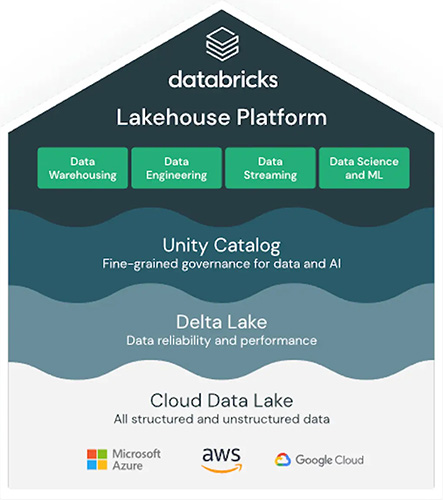
- Data Management: Databricks Lakehouse platform provides a unified data management layer that allows users to easily access and analyze data from various sources, including structured and unstructured data, real-time streams, and data lakes. It also provides data catalog, data governance and data lineage features that allows for easy discovery, understanding and trust of the data.
- Advanced analytics: Databricks allows for easy integration with other open-source tools and libraries like DeltaLake, MLflow, and Koalas, which can help data science teams to perform advanced analytics such as time-series analysis, image recognition and natural language processing.
Security for Artificial Intelligence
With HiddenLayer’s partnership, Databricks can now add security and enhanced integrity to its long list of benefits provided to data science teams. Enterprise companies worldwide are rapidly incorporating artificial intelligence into their tech stack and introducing ML Models as a new cybersecurity attack surface which need to be monitored and protected.
Cyber Threat Actors are continuously evolving and devising new adversarial machine learning tactics and techniques. Given that many Machine Learning model inputs and predictions are publicly exposed, they are inherently vulnerable to these new attacks. According to Gartner, “Through 2022, 30% of all AI cyberattacks will leverage training-data poisoning, AI model theft, or adversarial samples to attack AI-powered systems.”
HiddenLayer’s MLSecPlatform and its flagship product HiddenLayer MLDR will protect your ML Models via the Databricks integration. HiddenLayer MLDR is a first of its kind cybersecurity solution that monitors, detects, and responds to Adversarial Machine Learning attacks targeted at ML Models. Our patent-pending technology provides a noninvasive, software-based platform that monitors the inputs and outputs of your Machine Learning algorithms for anomalous activity consistent with adversarial ML attack techniques. Response actions are immediate with a flexible response framework to protect your ML. Using HiddenLayer empowers your company to:
- Protect your intellectual property: Proprietary Machine learning models are the definition of critical intellectual property. If ML models are not secured, they may be used by unauthorized parties without permission, cloned, or stolen. Companies who proactively secure their ML models can safeguard their organization's intellectual property from being compromised.
- Ensure data privacy: Machine Learning models are often trained on large amounts of data, which can include sensitive information. Left unsecured, this data may be accessed by unauthorized parties, leading to potential data breaches and regulatory violations.
- Maintain accuracy: Machine Learning models can be reverse engineered, poisoned, and altered, leading to decreased accuracy, efficacy, and trustworthiness.
- Preserve your competitive advantage: Machine Learning models give companies advantages over the competition. Left unsecured, others may be able to replicate your results and catch up to you. Securing your models helps ensure that you maintain your competitive advantage.
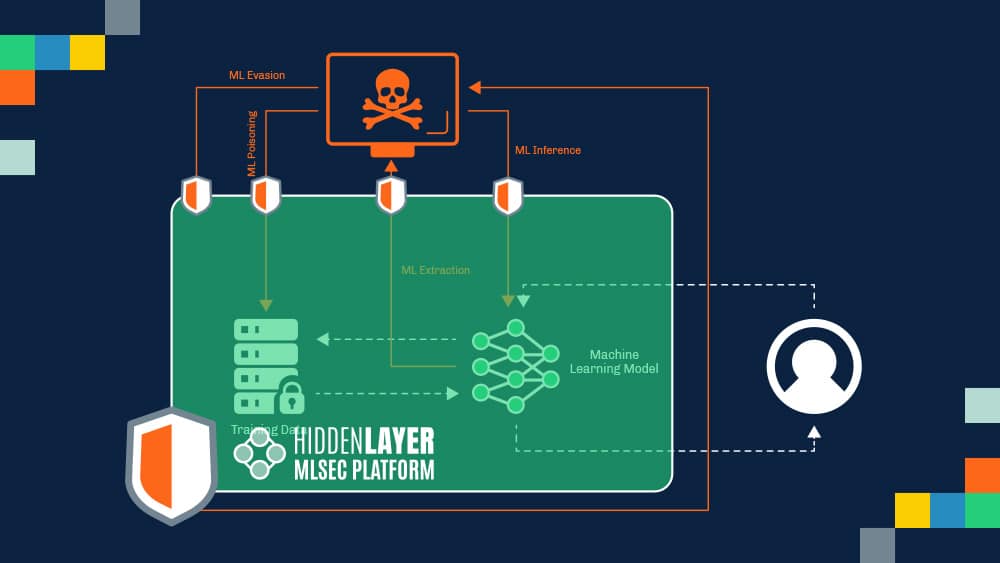
How HiddenLayer Integrates with Databricks
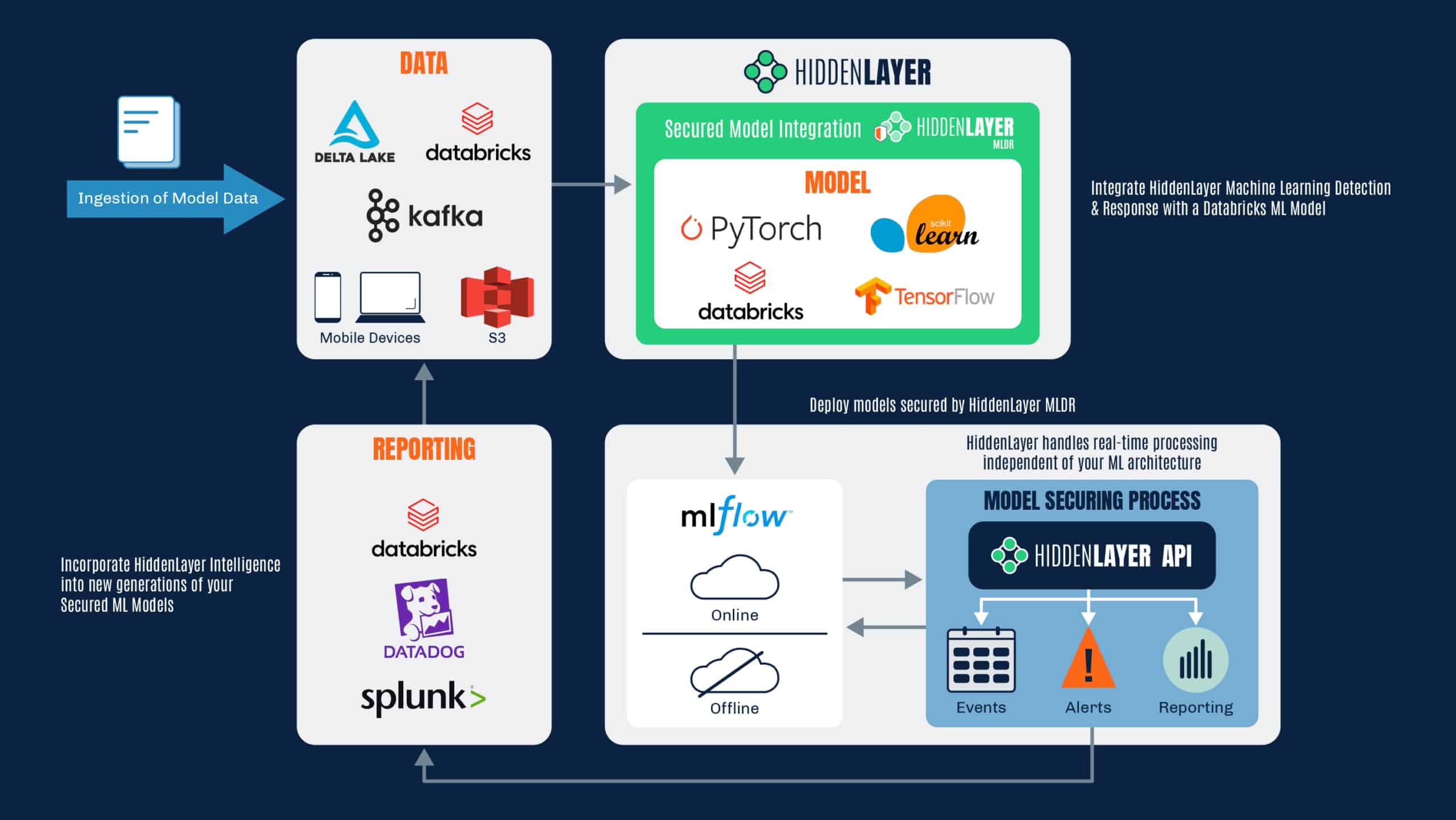
The HiddenLayer-Databricks integration wraps an ML model as it is registered (saved) in Databricks Lakehouse. The integration is model agnostic and includes model scanning and model detection and response. This enables Data Scientists and ML Engineers to add security to their models with no code or behavioral changes to their environment. As the model is loaded, it will be scanned by HiddenLayer's model scanner to ensure integrity as well as security. If an attack is detected, the integration will handle the response accordingly without any human interaction needed. With the peace of mind of ML Models protected by HiddenLayer, Data Science teams can focus their attention on building their advantage without sacrificing integrity or security.
Conclusion
Incorporating security into machine learning operations is critical for data science teams. With the increasing use of machine learning models in sensitive areas such as healthcare, finance, and national security, it is essential to ensure that machine learning models are secure and protected against malicious attacks. By embedding security throughout the entire machine learning lifecycle, from data collection to deployment, companies can ensure that their models are reliable and trustworthy.
Databricks Lakehouse Platform enables data science teams to design, develop, and deploy their ML Models rapidly while HiddenLayer MLSec Platform provides comprehensive security to protect, preserve, detect, and respond to Adversarial Machine Learning attacks on those models. Together, the two solutions empower your company to rapidly and securely deliver on your mission to advance your Artificial Intelligence strategy.
To learn more or try HiddenLayer’s integration with Databricks, please contact info@hiddenlayer.com.

Let’s Secure AI Together
Join HiddenLayer in shaping the standards, defenses, and future of AI security. Whether you’re a researcher, partner, or enterprise innovator, we’re stronger together.