
HiddenLayer in the News
See how our research, leadership, and innovations are shaping the global conversation on AI security.

min read
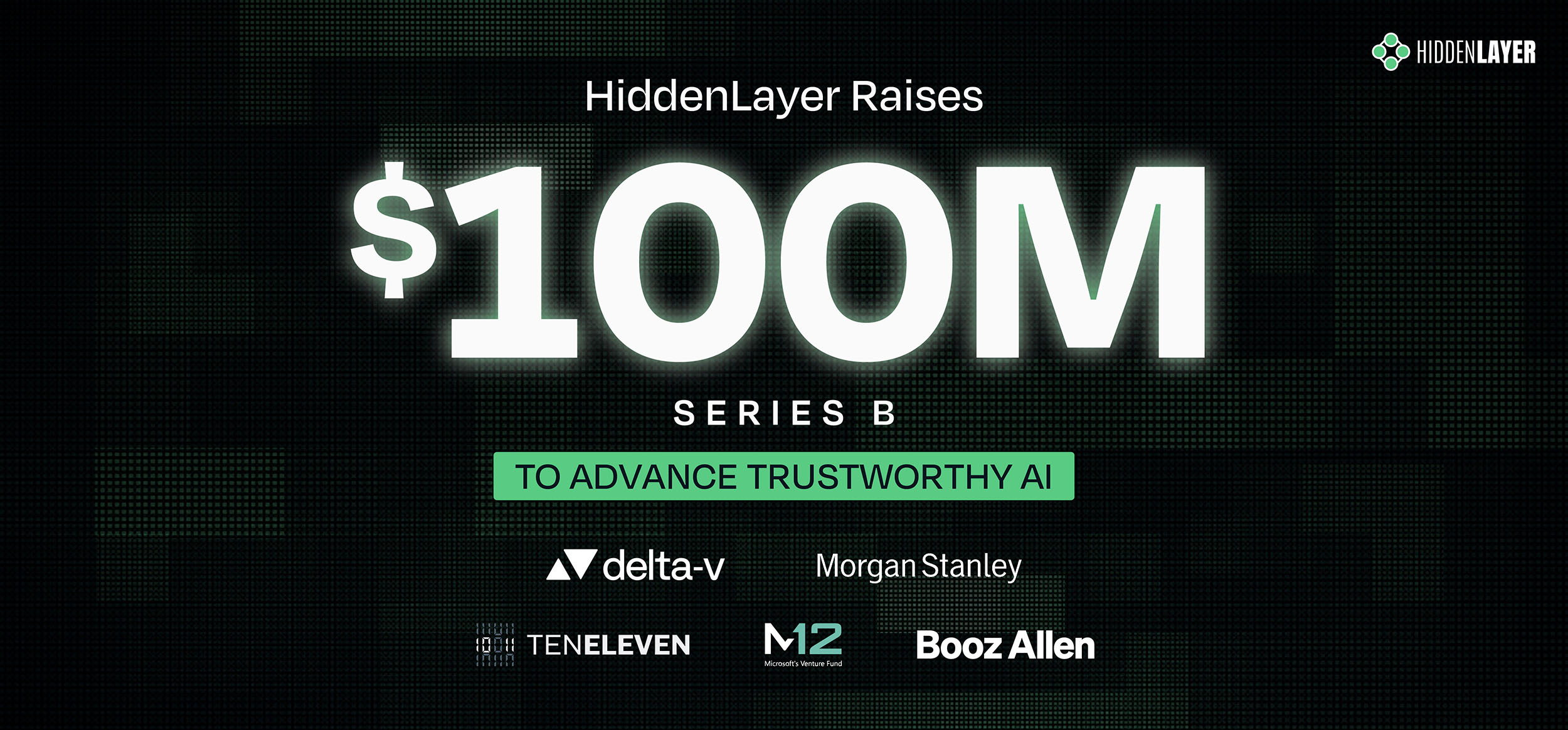
HiddenLayer Raises $100M Series B to Advance Trustworthy AI
HiddenLayer raises $100M in Series B funding to advance AI security, expand agentic runtime protection, and meet growing enterprise demand.
The investment comes as enterprises race to secure a rapidly expanding AI attack surface, from foundation models to the autonomous agents now writing and shipping code on their behalf.
September 2, 2026 – Austin, TX – HiddenLayer, the leading AI security company that secures agentic, generative, and predictive AI applications, today announced a $100 million Series B funding round led by Delta-v Capital, with participation from Ten Eleven Ventures, Morgan Stanley, M12, Microsoft's Venture Fund, and Booz Allen Ventures.
The company will use the funding to deepen its enterprise platform, including its Agentic Runtime Security capabilities, and Agent Harness Security, a new solution that extends the Runtime Security module to secure AI coding agents at runtime and protect enterprises adopting autonomous coding agents into their stack.
"We set out to pioneer trusted, secure use of AI for enterprises, long before most organizations saw the urgency we do today. This funding lets us keep growing the purpose-built team and platform required to meet that moment as agentic AI becomes core to how enterprises operate,” said Chris Sestito, CEO and Co-Founder of HiddenLayer.
The raise follows a standout year: HiddenLayer's annual recurring revenue grew more than 10x, and the company signed more than 50 new platform customers, including some of the largest names in securities brokerage, banking, insurance, accounting, government, technology, IT services, pharmaceuticals, airlines, and the US defense and intelligence communities. Internationally, new customers included one of the world's largest pharmaceutical companies, along with several premium automotive brands and food and beverage providers. HiddenLayer also supports a leading frontier model provider in securing more than 700 million weekly users.
This growth is underpinned by a world-class research team that has directly influenced how leading organizations protect their AI systems. HiddenLayer's researchers hold 39 granted patents and 65 pending patents spanning adversarial detection, model protection, and AI threat analysis. The team developed the first comprehensive Adversarial Prompt Engineering (APE) Taxonomy and continues to research emerging threats across generative, predictive, and agentic AI, identifying dozens of vulnerabilities across the AI ecosystem, from foundation models to the tools and infrastructure that support them. HiddenLayer's researchers also contribute to the broader AI security community through work with organizations and initiatives including CISA/JCDC, MITRE, NIST, OWASP, and OpenSSF, improving red teaming methodologies and informing global discussions on AI governance and safety.
"Traditional security tools were built for code and infrastructure, not for models that can be poisoned, hijacked, or manipulated through their own inputs,” said Dan Williams, Partner at Delta-v Capital. "HiddenLayer built a platform from the ground up to secure AI across its full lifecycle, from the model at its core to the agentic systems being layered on top and whatever architecture comes next. We’ve watched this team turn deep adversarial-AI research into a product CISOs actually rely on, and we're proud to partner with them."
The funding allows HiddenLayer to focus on the three fronts where enterprises are most exposed: Agentic Runtime Security, giving organizations visibility into how their AI agents behave in production, flagging and stopping manipulation, tool misuse, and unauthorized actions as they happen, and securing Agentic Harnesses and Autonomous Coding Agents that write, review, and ship code with much less human oversight than traditional development tools. As AI cannot be made trustworthy through design-time principles alone, there is no trustworthy AI without end-to-end AI-native security. Trust has to be continuously tested and proven at runtime. These capabilities are designed to give enterprises the confidence to trust their AI, with 96% of organizations already considering AI critical to their core operations, but nearly a third unable to say with certainty whether they've experienced an AI-related breach, according to HiddenLayer’s 2026 AI Threat Landscape Report.
“Enterprises don't shift budgets at this pace unless a problem is urgent. HiddenLayer's growth over the past year across defense, financial services, and some of the most sensitive AI deployments in the world demonstrates that security teams have concluded that AI needs its own category of protection,” said Mark Hatfield, Co-Founder and Partner at Ten Eleven Ventures. “We expect that conviction to continue to grow as autonomous systems become more and more integral to the enterprise."
“HiddenLayer was early to recognize that enterprise security is critical to the safe deployment of AI, and its buildout of an end-to-end platform to enable compliant AI adoption is an important contribution to addressing this market need,” said Zheng Wang, Head of Strategic Investments at Morgan Stanley. “We are delighted to be investing in HiddenLayer to foster its next phase of growth and innovation.”
HiddenLayer is also strengthening its leadership team, recently naming Mike Gesnaldo as Chief Revenue Officer. More hires are on the way as the company deepens its channel relationships, keeps pace with enterprise customer demand, and pushes further into international markets, beginning with Europe and the wider EMEA region.
About HiddenLayer
HiddenLayer secures agentic, generative, and predictive AI applications across the entire AI lifecycle, from discovery and AI supply chain security to attack simulation and runtime protection. Backed by patented technology and industry-leading adversarial AI research, our platform is purpose-built to defend AI systems against evolving threats. HiddenLayer protects intellectual property, helps ensure regulatory compliance, and enables organizations to safely adopt and scale AI with confidence.
About Delta-v Capital
Delta-v Capital (“Delta-v”) partners with visionary leaders of technology companies to accelerate their next phase of growth. Delta-v is a sector-focused investor with expertise in infrastructure software, cloud services, vertical software, and digital infrastructure. The firm provides flexible growth capital to support organic growth, strategic acquisitions, and shareholder liquidity, partnering with management teams and existing investors as companies scale. Delta-v currently manages over $1.6B in assets on behalf of institutional and individual investors. For more information, please visit www.deltavcapital.com or follow Delta-v Capital on LinkedIn.
Contact
SutherlandGold for HiddenLayer
hiddenlayer@sutherlandgold.com
min read
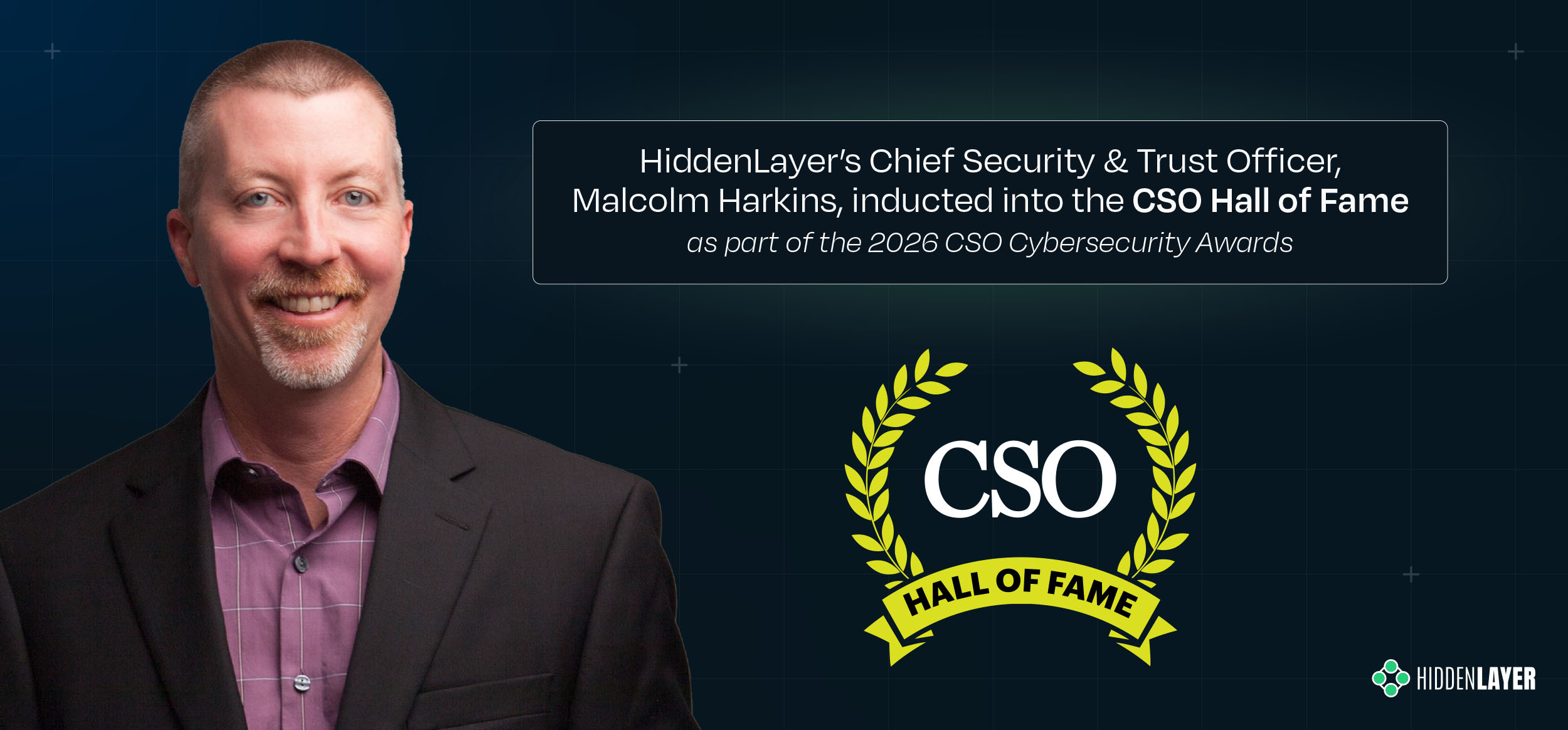
HiddenLayer’s Malcolm Harkins Inducted into the CSO Hall of Fame
Austin, TX — March 10, 2026 — HiddenLayer, the leading AI security company protecting enterprises from adversarial machine learning and emerging AI-driven threats, today announced that Malcolm Harkins, Chief Security & Trust Officer, has been inducted into the CSO Hall of Fame, recognizing his decades-long contributions to advancing cybersecurity and information risk management.
The CSO Hall of Fame honors influential leaders who have demonstrated exceptional impact in strengthening security practices, building resilient organizations, and advancing the broader cybersecurity profession. Harkins joins an accomplished group of security executives recognized for shaping how organizations manage risk and defend against emerging threats.
Throughout his career, Harkins has helped organizations navigate complex security challenges while aligning cybersecurity with business strategy. His work has focused on strengthening governance, improving risk management practices, and helping enterprises responsibly adopt emerging technologies, including artificial intelligence.
At HiddenLayer, Harkins plays a key role in guiding the company’s security and trust initiatives as organizations increasingly deploy AI across critical business functions. His leadership helps ensure that enterprises can adopt AI securely while maintaining resilience, compliance, and operational integrity.
“Malcolm’s career has consistently demonstrated what it means to lead in cybersecurity,” said Chris Sestito, CEO and Co-founder of HiddenLayer. “His commitment to advancing security risk management and helping organizations navigate emerging technologies has had a lasting impact across the industry. We’re incredibly proud to see him recognized by the CSO Hall of Fame.”
The 2026 CSO Hall of Fame inductees will be formally recognized at the CSO Cybersecurity Awards & Conference, taking place May 11–13, 2026, in Nashville, Tennessee.
The CSO Hall of Fame, presented by CSO, recognizes security leaders whose careers have significantly advanced the practice of information risk management and security. Inductees are selected for their leadership, innovation, and lasting contributions to the cybersecurity community.
About HiddenLayer
HiddenLayer secures agentic, generative, and predictive AI applications across the entire AI lifecycle, from discovery and AI supply chain security to attack simulation and runtime protection. Backed by patented technology and industry-leading adversarial AI research, our platform is purpose-built to defend AI systems against evolving threats. HiddenLayer protects intellectual property, helps ensure regulatory compliance, and enables organizations to safely adopt and scale AI with confidence.
Contact
SutherlandGold for HiddenLayer
hiddenlayer@sutherlandgold.com
min read
HiddenLayer Selected as Awardee on $151B Missile Defense Agency SHIELD IDIQ Supporting the Golden Dome Initiative
Underpinning HiddenLayer’s unique solution for the DoD and USIC is HiddenLayer’s Airgapped AI Security Platform, the first solution designed to protect AI models and development processes in fully classified, disconnected environments. Deployed locally within customer-controlled environments, the platform supports strict US Federal security requirements while delivering enterprise-ready detection, scanning, and response capabilities essential for national security missions.
Austin, TX – December 23, 2025 – HiddenLayer, the leading provider of Security for AI, today announced it has been selected as an awardee on the Missile Defense Agency’s (MDA) Scalable Homeland Innovative Enterprise Layered Defense (SHIELD) multiple-award, indefinite-delivery/indefinite-quantity (IDIQ) contract. The SHIELD IDIQ has a ceiling value of $151 billion and serves as a core acquisition vehicle supporting the Department of Defense’s Golden Dome initiative to rapidly deliver innovative capabilities to the warfighter.
The program enables MDA and its mission partners to accelerate the deployment of advanced technologies with increased speed, flexibility, and agility. HiddenLayer was selected based on its successful past performance with ongoing US Federal contracts and projects with the Department of Defence (DoD) and United States Intelligence Community (USIC). “This award reflects the Department of Defense’s recognition that securing AI systems, particularly in highly-classified environments is now mission-critical,” said Chris “Tito” Sestito, CEO and Co-founder of HiddenLayer. “As AI becomes increasingly central to missile defense, command and control, and decision-support systems, securing these capabilities is essential. HiddenLayer’s technology enables defense organizations to deploy and operate AI with confidence in the most sensitive operational environments.”
Underpinning HiddenLayer’s unique solution for the DoD and USIC is HiddenLayer’s Airgapped AI Security Platform, the first solution designed to protect AI models and development processes in fully classified, disconnected environments. Deployed locally within customer-controlled environments, the platform supports strict US Federal security requirements while delivering enterprise-ready detection, scanning, and response capabilities essential for national security missions.
HiddenLayer’s Airgapped AI Security Platform delivers comprehensive protection across the AI lifecycle, including:
- Comprehensive Security for Agentic, Generative, and Predictive AI Applications: Advanced AI discovery, supply chain security, testing, and runtime defense.
- Complete Data Isolation: Sensitive data remains within the customer environment and cannot be accessed by HiddenLayer or third parties unless explicitly shared.
- Compliance Readiness: Designed to support stringent federal security and classification requirements.
- Reduced Attack Surface: Minimizes exposure to external threats by limiting unnecessary external dependencies.
“By operating in fully disconnected environments, the Airgapped AI Security Platform provides the peace of mind that comes with complete control,” continued Sestito. “This release is a milestone for advancing AI security where it matters most: government, defense, and other mission-critical use cases.”
The SHIELD IDIQ supports a broad range of mission areas and allows MDA to rapidly issue task orders to qualified industry partners, accelerating innovation in support of the Golden Dome initiative’s layered missile defense architecture.
Performance under the contract will occur at locations designated by the Missile Defense Agency and its mission partners.
About HiddenLayer
HiddenLayer, a Gartner-recognized Cool Vendor for AI Security, is the leading provider of Security for AI. Its security platform helps enterprises safeguard their agentic, generative, and predictive AI applications. HiddenLayer is the only company to offer turnkey security for AI that does not add unnecessary complexity to models and does not require access to raw data and algorithms. Backed by patented technology and industry-leading adversarial AI research, HiddenLayer’s platform delivers supply chain security, runtime defense, security posture management, and automated red teaming.
Contact
SutherlandGold for HiddenLayer
hiddenlayer@sutherlandgold.com
min read
HiddenLayer Announces AWS GenAI Integrations, AI Attack Simulation Launch, and Platform Enhancements to Secure Bedrock and AgentCore Deployments
As organizations rapidly adopt generative AI, they face increasing risks of prompt injection, data leakage, and model misuse. HiddenLayer’s security technology, built on AWS, helps enterprises address these risks while maintaining speed and innovation.
AUSTIN, TX — December 1, 2025 — HiddenLayer, the leading AI security platform for agentic, generative, and predictive AI applications, today announced expanded integrations with Amazon Web Services (AWS) Generative AI offerings and a major platform update debuting at AWS re:Invent 2025. HiddenLayer offers additional security features for enterprises using generative AI on AWS, complementing existing protections for models, applications, and agents running on Amazon Bedrock, Amazon Bedrock AgentCore, Amazon SageMaker, and SageMaker Model Serving Endpoints.
As organizations rapidly adopt generative AI, they face increasing risks of prompt injection, data leakage, and model misuse. HiddenLayer’s security technology, built on AWS, helps enterprises address these risks while maintaining speed and innovation.
“As organizations embrace generative AI to power innovation, they also inherit a new class of risks unique to these systems,” said Chris Sestito, CEO and Co-Founder of HiddenLayer. “Working with AWS, we’re ensuring customers can innovate safely, bringing trust, transparency, and resilience to every layer of their AI stack.”
Built on AWS to Accelerate Secure AI Innovation
HiddenLayer’s AI Security Platform and integrations are available in AWS Marketplace, offering native support for Amazon Bedrock and Amazon SageMaker. The company complements AWS infrastructure security by providing AI-specific threat detection, identifying risks within model inference and agent cognition that traditional tools overlook.
Through automated security gates, continuous compliance validation, and real-time threat blocking, HiddenLayer enables developers to maintain velocity while giving security teams confidence and auditable governance for AI deployments.
Alongside these integrations, HiddenLayer is introducing a complete platform redesign and the launches of a new AI Discovery module and an enhanced AI Attack Simulation module, further strengthening its end-to-end AI Security Platform that protects agentic, generative, and predictive AI systems.
Key enhancements include:
- AI Discovery: Identifies AI assets within technical environments to build AI asset inventories
- AI Attack Simulation: Automates adversarial testing and Red Teaming to identify vulnerabilities before deployment.
- Complete UI/UX Revamp: Simplified sidebar navigation and reorganized settings for faster workflows across AI Discovery, AI Supply Chain Security, AI Attack Simulation, and AI Runtime Security.
- Enhanced Analytics: Filterable and exportable data tables, with new module-level graphs and charts.
- Security Dashboard Overview: Unified view of AI posture, detections, and compliance trends.
- Learning Center: In-platform documentation and tutorials, with future guided walkthroughs.
HiddenLayer will demonstrate these capabilities live at AWS re:Invent 2025, December 1–5 in Las Vegas.
To learn more or request a demo, visit https://hiddenlayer.com/reinvent2025/.
About HiddenLayer
HiddenLayer, a Gartner-recognized Cool Vendor for AI Security, is the leading provider of Security for AI. Its platform helps enterprises safeguard agentic, generative, and predictive AI applications without adding unnecessary complexity or requiring access to raw data and algorithms. Backed by patented technology and industry-leading adversarial AI research, HiddenLayer delivers supply chain security, runtime defense, posture management, and automated red teaming.
For more information, visit www.hiddenlayer.com.
Press Contact:
SutherlandGold for HiddenLayer
hiddenlayer@sutherlandgold.com
min read
HiddenLayer Joins Databricks’ Data Intelligence Platform for Cybersecurity
On September 30, Databricks officially launched its <a href="https://www.databricks.com/blog/transforming-cybersecurity-data-intelligence?utm_source=linkedin&utm_medium=organic-social">Data Intelligence Platform for Cybersecurity</a>, marking a significant step in unifying data, AI, and security under one roof. At HiddenLayer, we’re proud to be part of this new data intelligence platform, as it represents a significant milestone in the industry's direction.
On September 30, Databricks officially launched its Data Intelligence Platform for Cybersecurity, marking a significant step in unifying data, AI, and security under one roof. At HiddenLayer, we’re proud to be part of this new data intelligence platform, as it represents a significant milestone in the industry's direction.
Why Databricks’ Data Intelligence Platform for Cybersecurity Matters for AI Security
Cybersecurity and AI are now inseparable. Modern defenses rely heavily on machine learning models, but that also introduces new attack surfaces. Models can be compromised through adversarial inputs, data poisoning, or theft. These attacks can result in missed fraud detection, compliance failures, and disrupted operations.
Until now, data platforms and security tools have operated mainly in silos, creating complexity and risk.
The Databricks Data Intelligence Platform for Cybersecurity is a unified, AI-powered, and ecosystem-driven platform that empowers partners and customers to modernize security operations, accelerate innovation, and unlock new value at scale.
How HiddenLayer Secures AI Applications Inside Databricks
HiddenLayer adds the critical layer of security for AI models themselves. Our technology scans and monitors machine learning models for vulnerabilities, detects adversarial manipulation, and ensures models remain trustworthy throughout their lifecycle.
By integrating with Databricks Unity Catalog, we make AI application security seamless, auditable, and compliant with emerging governance requirements. This empowers organizations to demonstrate due diligence while accelerating the safe adoption of AI.
The Future of Secure AI Adoption with Databricks and HiddenLayer
The Databricks Data Intelligence Platform for Cybersecurity marks a turning point in how organizations must approach the intersection of AI, data, and defense. HiddenLayer ensures the AI applications at the heart of these systems remain safe, auditable, and resilient against attack.
As adversaries grow more sophisticated and regulators demand greater transparency, securing AI is an immediate necessity. By embedding HiddenLayer directly into the Databricks ecosystem, enterprises gain the assurance that they can innovate with AI while maintaining trust, compliance, and control.
In short, the future of cybersecurity will not be built solely on data or AI, but on the secure integration of both. Together, Databricks and HiddenLayer are making that future possible.
FAQ: Databricks and HiddenLayer AI Security
What is the Databricks Data Intelligence Platform for Cybersecurity?
The Databricks Data Intelligence Platform for Cybersecurity delivers the only unified, AI-powered, and ecosystem-driven platform that empowers partners and customers to modernize security operations, accelerate innovation, and unlock new value at scale.
Why is AI application security important?
AI applications and their underlying models can be attacked through adversarial inputs, data poisoning, or theft. Securing models reduces risks of fraud, compliance violations, and operational disruption.
How does HiddenLayer integrate with Databricks?
HiddenLayer integrates with Databricks Unity Catalog to scan models for vulnerabilities, monitor for adversarial manipulation, and ensure compliance with AI governance requirements.
min read
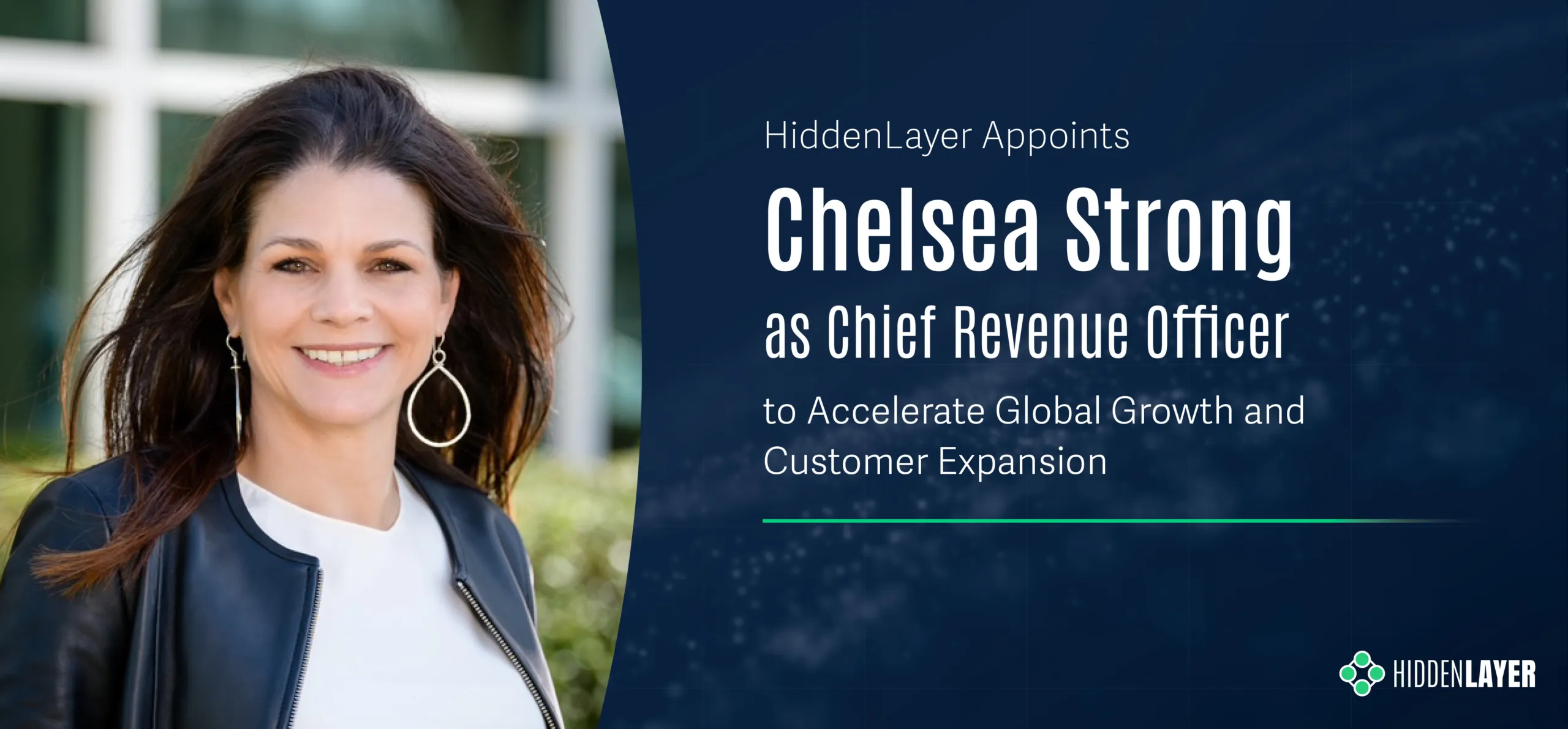
HiddenLayer Appoints Chelsea Strong as Chief Revenue Officer to Accelerate Global Growth and Customer Expansion
As CRO, Strong will lead HiddenLayer’s global sales strategy, customer success, and go-to-market execution as the company continues to meet surging demand for AI/ML security solutions across industries. Her appointment signals HiddenLayer’s continued commitment to building a world-class executive team with deep experience in navigating rapid expansion while staying focused on customer success.
AUSTIN, TX — July 16, 2025 — HiddenLayer, the leading provider of security solutions for artificial intelligence, is proud to announce the appointment of Chelsea Strong as Chief Revenue Officer (CRO). With over 25 years of experience driving enterprise sales and business development across the cybersecurity and technology landscape, Strong brings a proven track record of scaling revenue operations in high-growth environments.
As CRO, Strong will lead HiddenLayer’s global sales strategy, customer success, and go-to-market execution as the company continues to meet surging demand for AI/ML security solutions across industries. Her appointment signals HiddenLayer’s continued commitment to building a world-class executive team with deep experience in navigating rapid expansion while staying focused on customer success.
“Chelsea brings a rare combination of startup precision and enterprise scale,” said Chris Sestito, CEO and Co-Founder of HiddenLayer. “She’s not only built and led high-performing teams at some of the industry’s most innovative companies, but she also knows how to establish the infrastructure for long-term growth. We’re thrilled to welcome her to the leadership team as we continue to lead in AI security.”
Before joining HiddenLayer, Strong held senior leadership positions at cybersecurity innovators, including HUMAN Security, Blue Lava, and Obsidian Security, where she specialized in building teams, cultivating customer relationships, and shaping emerging markets. She also played pivotal early sales roles at CrowdStrike and FireEye, contributing to their go-to-market success ahead of their IPOs.
“I’m excited to join HiddenLayer at such a pivotal time,” said Strong. “As organizations across every sector rapidly deploy AI, they need partners who understand both the innovation and the risk. HiddenLayer is uniquely positioned to lead this space, and I’m looking forward to helping our customers confidently secure wherever they are in their AI journey.”
With this appointment, HiddenLayer continues to attract top talent to its executive bench, reinforcing its mission to protect the world’s most valuable machine learning assets.
About HiddenLayer
HiddenLayer, a Gartner-recognized Cool Vendor for AI Security, is the leading provider of Security for AI. Its security platform helps enterprises safeguard the machine learning models behind their most important products. HiddenLayer is the only company to offer turnkey security for AI that does not add unnecessary complexity to models and does not require access to raw data and algorithms. Founded by a team with deep roots in security and ML, HiddenLayer aims to protect enterprise AI from inference, bypass, extraction attacks, and model theft. The company is backed by a group of strategic investors, including M12, Microsoft’s Venture Fund, Moore Strategic Ventures, Booz Allen Ventures, IBM Ventures, and Capital One Ventures.
Press Contact
Victoria Lamson
SutherlandGold for HiddenLayer
hiddenlayer@sutherlandgold.com
min read
HiddenLayer Listed in AWS “ICMP” for the US Federal Government
HiddenLayer’s inclusion in the AWS ICMP enables rapid acquisition and implementation of advanced AI security technology, all while maintaining compliance with strict federal standards.
AUSTIN, TX — July 1, 2025 — HiddenLayer, the leading provider of security for AI models and assets, today announced that it listed its AI Security Platform in the AWS Marketplace for the U.S. Intelligence Community (ICMP). ICMP is a curated digital catalog from Amazon Web Services (AWS) that makes it easy to discover, purchase, and deploy software packages and applications from vendors that specialize in supporting government customers.
HiddenLayer’s inclusion in the AWS ICMP enables rapid acquisition and implementation of advanced AI security technology, all while maintaining compliance with strict federal standards.
“Listing in the AWS ICMP opens a significant pathway for delivering AI security where it’s needed most, at the core of national security missions,” said Chris Sestito, CEO and Co-Founder of HiddenLayer. “We’re proud to be among the companies available in this catalog and are committed to supporting U.S. federal agencies in the safe deployment of AI.”
HiddenLayer is also available to customers in AWS Marketplace, further supporting government efforts to secure AI systems across agencies.
About HiddenLayer
HiddenLayer, a Gartner-recognized Cool Vendor for AI Security, is the leading provider of Security for AI. Its security platform helps enterprises safeguard the machine learning models behind their most important products. HiddenLayer is the only company to offer turnkey security for AI that does not add unnecessary complexity to models and does not require access to raw data and algorithms. Founded by a team with deep roots in security and ML, HiddenLayer aims to protect enterprise AI from inference, bypass, extraction attacks, and model theft. The company is backed by a group of strategic investors, including M12, Microsoft’s Venture Fund, Moore Strategic Ventures, Booz Allen Ventures, IBM Ventures, and Capital One Ventures.
Press Contact
Victoria Lamson
SutherlandGold for HiddenLayer
hiddenlayer@sutherlandgold.com



Let’s Secure AI Together
Join HiddenLayer in shaping the standards, defenses, and future of AI security. Whether you’re a researcher, partner, or enterprise innovator, we’re stronger together.